
O-1A Approval · Software Engineering
Cloud-Native Engineering for Healthcare and
Government Platforms
This case shows how real-world technical impact, enterprise adoption, and repeated field-level recognition can meet the O-1A standard, even without academic publications or patents. The approval also came in just ahead of his STEM OPT expiration in June 2026, with the profile built over roughly 12 to 15 months while he worked full time.
Overview of the O1A Case
Our client works in the specialized area of cloud-native software engineering, with a focus on automation and performance work for HIPAA-compliant healthcare platforms and government case management systems.
As regulated industries modernize and move workloads to the cloud, this area has become increasingly critical. The specialized nature and national importance of this work also helped support both the O-1A petition and the client’s long-term employment-based green card strategy.
Instead of relying on job titles or generic engineering responsibilities, the petition focused on:
The originality of the client’s technical contributions
The measurable impact of those contributions in production systems
The reliance of large organizations on the client’s work
The client’s standing among peers working on similar problems
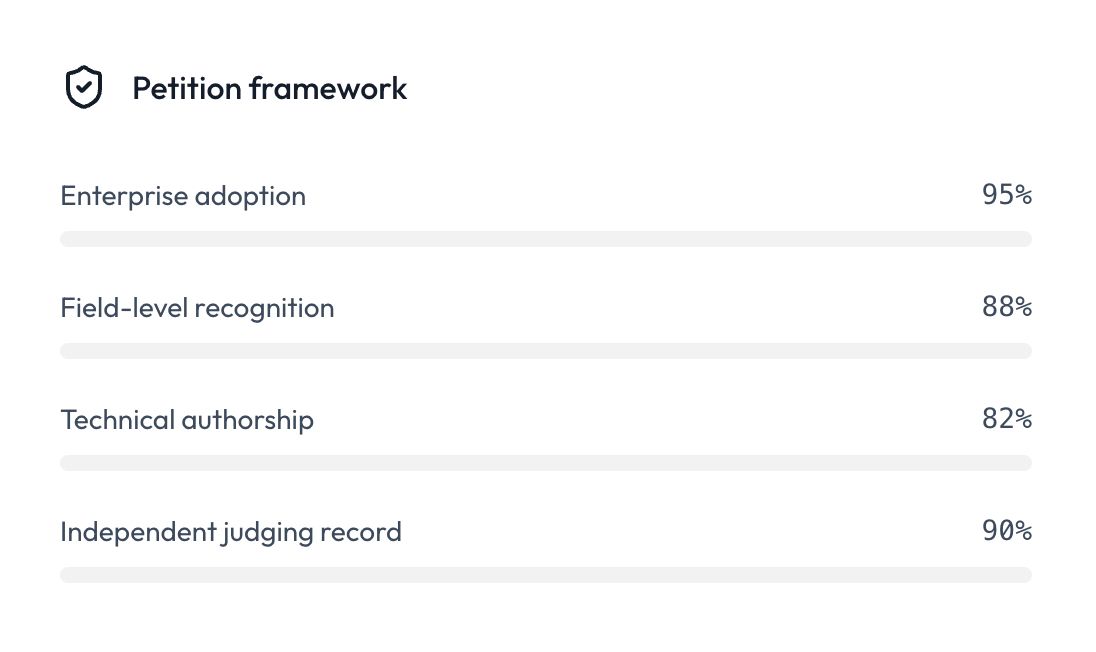
Four pillars of the petition.
USCIS evaluates eight criteria. Here are the four that carried this approval, each grounded in real, production-level engineering work.
01

Original Contributions of Major Significance
Specific contributions included HIPAA-compliant healthcare applications running in regulated environments, automation frameworks deployed inside enterprise case management platforms used by government agencies, performance and latency improvements across data processing pipelines, SQL and data pipeline optimization at production scale, cloud architecture built on Microsoft Azure services, and CI/CD pipelines that improved release cycles and deployment reliability.
Most importantly, the petition demonstrated how these contributions were implemented, adopted, and relied upon in real production environments. Major significance was established through usage and impact, not theoretical claims.
02

Critical Role for a Distinguished Organization
The petition showed that the client had decision-making authority over automation framework design, owned system-level architecture decisions rather than just implementation, was accountable for performance, security, and deployment processes, and played a key role in healthcare and government platform development where the stakes were higher than usual. USCIS evaluates critical role based on organizational reliance, and the evidence clearly demonstrated that this work could not be easily replaced.
03

Authorship of Technical Articles and Industry Insight
Authorship was framed as professional scholarship grounded in production-level engineering, not academic theory. The client’s articles covered microservices architecture tradeoffs, SQL query optimization techniques, CI/CD pipeline efficiency, AI in DevOps workflows, and automation frameworks including LLM-based systems.
Each piece read as applied insight from systems the client had actually built or debugged.
That alignment between authorship and real engineering work made the body of writing credible and reinforced the client’s standing as a recognized practitioner shaping how peers think about cloud, automation, and DevOps.
04

Supporting Evidence: Judging the Work of Others & Expert Recognition
Judging in O-1A cases is not about participation. It is about being selected repeatedly by independent organizations. The client’s record reflected exactly that, including university-level technical evaluations such as UT Austin, hackathons including Washington Hackathon 2025, STEM programs like Technovation Girls, innovation challenges in healthcare and technology, business and analytics award panels, science fairs such as Buckeye Science Fair, and reviewer roles for international conferences, academic journals, and technical research submissions.
Independent experts further confirmed that the client’s work represented a meaningful advancement in cloud-native engineering for regulated industries, that his solutions were relied upon in high-stakes production systems serving healthcare and government users, and that his technical judgment influenced how automation, CI/CD, and Azure-based architectures were implemented at scale.
These expert and judging perspectives helped USCIS understand why the client’s work mattered beyond a single employer.

“O-1A is about impact, not fame. You don’t need public notoriety you need evidence that your work is relied upon and matters.”
— Team Jinee
03 — Takeaways
What you can learn from this O1A Approval
01
Impact over fame
You don’t need notoriety. You need evidence your work is relied upon.
02
Internal work qualifies
Non-public systems can win when usage and criticality are positioned correctly.
03
Letters validate substance
Expert letters should confirm real contributions, not manufacture them.
04
Specialization wins
Cloud-native, HIPAA, DevOps and automation are strong O-1A fits.
High approval rates.
Stronger with strategy.
Outcomes still depend heavily on evidence quality and strategy. Strong cases succeed when they clearly explain why an individual’s work rises above routine professional contributions.
O1 Visa Approval Rates and Why Strategy Matters
While O-1 visa approval rates are generally high, outcomes still depend heavily on evidence quality and strategy. Strong cases succeed when they clearly explain why the individual’s work rises above routine professional contributions.
This case demonstrates that a well-structured O-1A petition grounded in real technical impact and supported by credible expert insight can succeed even without traditional academic credentials, brand-name employers, or patents.