
Do I Need a Minimum Salary to Qualify for EB-1A or NIW
No. There is no minimum salary requirement for either EB-1A or EB-2 NIW. But that doesn’t mean salary is irrelevant. For EB-1A, high remuneration is one of ten regulatory criteria an applicant can choose to rely on. For NIW, salary is not one of the three Dhanasar prongs. Unlike employer-sponsored EB-2 and EB-3, where the offered wage must meet the prevailing wage through PERM, self-petitioned categories work differently. At Jinee Green Card, income can appear as supporting evidence in your petition, but it is never a threshold you need to clear first.
Team Jinee
Extraordinary Ability. Precisely Positioned.

September 2026

7 min read
93%
Jinee approval rate
No minimum
Salary threshold for EB-1A/NIW
10 criteria / 3-prong test
EB-1A and NIW’s evidentiary paths
2026 standard
USCIS aligned
On This Page
Is There a Minimum Salary for EB-1A?
Why This Myth Persists?
When Does Income Actually Matter??
What If Your Salary Is Low or Irregular?
Why Choose Jinee Green Card?
FAQs
References
EB-1A and EB-2 NIW are both self-petitioned, merit-based categories, which means neither one requires a job offer, a labor certification, or a minimum salary threshold. That is fundamentally different from standard EB-2 and EB-3, where an employer must pay at least the government-determined prevailing wage. For EB-1A and NIW, what counts is the strength of your evidence and the impact of your work. Income can support that evidence, but it is not a gate you need to pass through first.
The confusion is understandable. Most employment-based green card categories, including standard EB-2 and EB-3, are anchored to a specific wage figure because they depend on an employer’s PERM labor certification. EB-1A and NIW don’t follow that model. Both are self-petitioned, merit-based categories, which is why the evidentiary questions center on impact and recognition rather than a compensation figure that has to be matched or exceeded.
According to Jinee Green Card, “Applicants often carry over expectations from PERM-based filings, where meeting or exceeding the prevailing wage is a hard requirement. EB-1A and NIW don’t work that way. Salary can appear inside an EB-1A petition as one of ten criteria, and it can support the positioning prong in an NIW case, but neither category treats it as a number you need to clear before anything else counts.”
At Jinee Green Card, our EB-1A case reviews start by mapping which of the ten criteria, or which Dhanasar prong, an applicant’s existing evidence already supports, income included, rather than assuming a compensation figure needs to be hit first.

01-
Is There a Minimum Salary for EB-1A?
If you do not have a one-time major, internationally recognized award, you generally need to satisfy at least three of the ten regulatory evidentiary criteria before USCIS conducts the final merits determination.
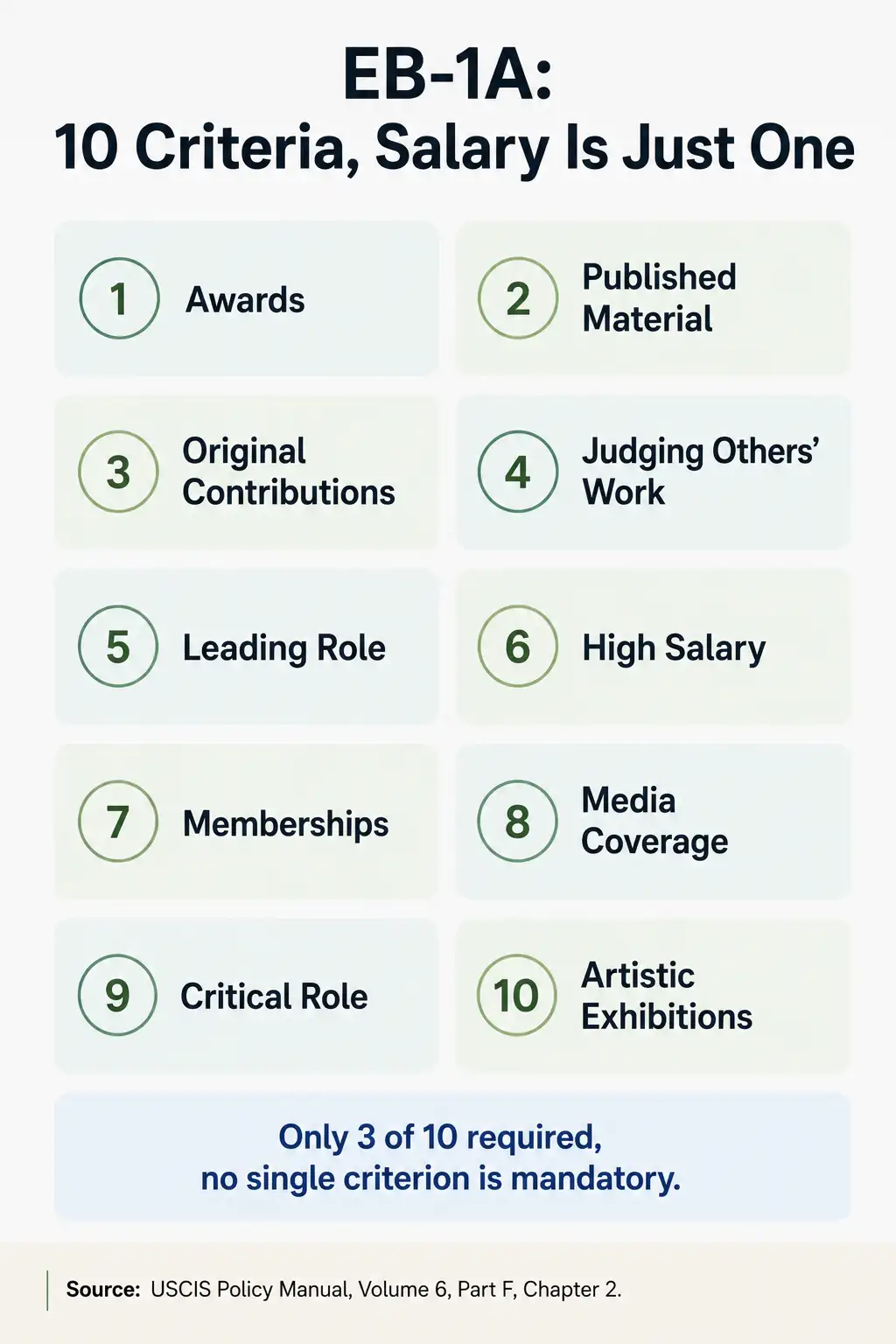
One of those ten criteria is evidence that you have commanded a high salary or other significantly high remuneration for services, in relation to others in your field. That is often where the confusion starts: people see “high salary” listed as a criterion and assume it is a requirement. It is not.
It is simply one of ten options, and you can build a strong EB-1A case using entirely different criteria such as awards, published material, original contributions, judging others’ work, or memberships in selective associations, without ever touching the salary criterion at all.
There is also no fixed dollar figure USCIS uses here. If you do choose to rely on the high-salary criterion, the comparison is relative, meaning your pay compared to others in the same field and geography, not a fixed national threshold.
Applicants weighing which of the ten criteria fit their record can also review our related guide on Indian IT professionals and EB-1A evidence for a closer look at how technical and field-specific impact gets documented.
02-
Is There a Minimum Salary for NIW?
EB-2 NIW eligibility is built on two layers: the underlying EB-2 requirements (an advanced degree or exceptional ability) and a three-prong national interest test. That test asks whether your proposed work has substantial merit and national importance, whether you are well positioned to advance it, and whether waiving the job offer and labor certification requirement benefits the United States. Salary does not appear anywhere in that framework.
An approved NIW waives the job-offer and labor-certification requirements that ordinarily apply to this employment-based route. Because an NIW applicant does not need to obtain a PERM labor certification, there is no PERM prevailing wage requirement to satisfy. As an NIW applicant, you do not need an employer, a job offer, or a wage determination at all.
03-
Why This Myth Persists?
A few things tend to feed this misconception:
- Confusion with PERM-based categories. Standard EB-2 and EB-3 require the offered wage to meet or exceed the prevailing wage, since those categories depend on an employer-filed labor certification. It is an easy detail to mistakenly apply to EB-1A or NIW, which do not work the same way.
- The “high salary” criterion in EB-1A. Because it is explicitly listed as one of the ten criteria, people sometimes read it as a baseline requirement rather than one optional category of evidence among many.
- Confusion with H-1B’s wage-weighted lottery. Since H-1B selection now factors in offered wage level, some applicants assume every U.S. immigration category runs on a similar salary logic. EB-1A and NIW do not.
04-
When Does Income Actually Matter?
Income is not irrelevant to these petitions. It just does not function as a threshold. Here are a few places it can genuinely help:
As one of ten EB-1A criteria, if your compensation is demonstrably high relative to peers in your field, it can serve as supporting evidence of extraordinary ability alongside other criteria.
As context for NIW’s national importance and positioning prongs, where evidence of grants, contracts, or funding can help demonstrate that you are well-resourced and positioned to carry out your proposed work.
As general credibility support, since documented earnings, contracts, or investment can reinforce a narrative of professional standing, even when the petition does not formally require it.
None of this means income is a checkbox. It is one thread among many you can choose to weave into your case, not a bar every case has to clear.
05-
What If Your Salary Is Low or Irregular?
A low or irregular salary does not automatically weaken an EB-1A or NIW petition. The relevance of compensation depends on the case. For EB-1A applicants relying on the high-remuneration criterion, the evidence must show that their compensation is high relative to others in the field. For NIW applicants, evidence of funding, contracts, or other resources may help demonstrate the ability to advance the proposed endeavor, but there is no minimum salary requirement.
This tends to come up most for applicants in situations like:
- Early-career researchers who are grant-funded rather than commercially compensated.
- Founders of early-stage companies who are prioritizing product development or reinvestment over drawing a full salary.
- Academics whose compensation follows institutional pay norms that run lower than industry benchmarks.
- Self-employed or consulting professionals with irregular income that does not map neatly onto a standard salary figure.
In each of these situations, the stronger move is addressing the context directly in your petition, explaining the funding structure, the stage of the venture, or the field’s compensation norms, rather than leaving USCIS to guess. What ultimately carries the case is documented impact: citations, adoption of your work, policy influence, or field recognition, not the size of a paycheck.

FREE EVALUATION
Get a free case evaluation from our team. We will review your specific situation and tell you exactly how to frame it if it needs addressing.
06-
Why Choose Jinee Green Card?
At Jinee Green Card, we’ve helped more than 500 professionals get approved, at a 93% success rate, across EB-1A, O-1A, and EB-2 NIW. We regularly work with researchers, founders, and consultants whose compensation does not look like a typical corporate salary, and part of our job is making sure that gets framed correctly rather than becoming an unnecessary obstacle. Our team includes immigration attorneys and professionals with USCIS adjudication experience, and we help applicants identify which evidence is most relevant to their particular immigration strategy.
07-
Frequently Asked Questions
Do I need a high salary to qualify for EB-1A?
No. High salary is one of ten optional EB-1A criteria. If an applicant doesn’t have a single, major internationally recognized award, they generally need to satisfy at least three of the ten regulatory criteria before USCIS moves on to the final merits determination. A strong case can be built entirely on other criteria such as awards, publications, original contributions, or leadership roles, without relying on salary at all.
Does NIW require me to meet the prevailing wage?
No. NIW specifically waives the labor certification process, and the prevailing wage requirement is tied to that process. Since NIW applicants do not need a job offer or a PERM filing, prevailing wage does not apply to them.
Will a low salary hurt my EB-1A or NIW petition?
Not automatically, but it can prompt questions, especially for NIW, about whether the proposed work is economically viable. It is generally worth proactively explaining the context such as research funding, early-stage venture status, or academic pay norms, rather than leaving the gap unaddressed.
Can self-employed or freelance applicants qualify without a steady salary?
Yes. Self-employed and freelance applicants may qualify without a steady salary. Depending on the case and the evidence being relied on, contracts, invoices, business records, or other documentation may help establish their work, compensation, achievements, or ability to advance a proposed endeavor.
Is H-1B's salary-based lottery the same thing as an EB-1A or NIW salary requirement?
For the FY2027 H-1B cap season, USCIS introduced a weighted selection process based on the applicable OEWS wage level for the position and area of intended employment. This is specific to the H-1B cap-selection process; it does not create a salary threshold for EB-1A or NIW.
08-
References

USCIS Policy Manual — Extraordinary Ability (EB-1A)
USCIS Policy Manual — National Interest Waivers
Disclaimer
Understand where your profile stands before you file.