
JINEE GREEN CARD
Why Immigration Law Firms Work With Jinee Green Card
A Look at the Relationship Between Profile Development, Evidence Building, and Immigration Counsel
For someone researching Jinee Green Card reviews, one of the more interesting aspects of the company is its relationship with immigration law firms.
Jinee Green Card is not an immigration law firm.
Instead, the company operates primarily on the profile-development side of talent-based immigration, helping professionals identify, develop, organize, and document the professional accomplishments that may eventually become relevant to pathways such as O-1A, EB-1A, and EB-2 NIW.
Immigration attorneys serve a different role.
They evaluate legal eligibility, determine petition strategy, prepare legal arguments, advise clients on immigration law, and ultimately handle immigration filings.
That separation helps explain why Jinee has developed relationships with immigration attorneys and law firms rather than attempting to replace them.
On This Page
The Problem Often Starts Before Someone Is Ready to File
Why This Matters for Attorneys
Why Evidence Quality Matters
Jinee Doesn’t Decide Immigration Eligibility
What Collaboration Can Look Like in Practice
Why Would a Law Firm Refer Someone to a Profile-Development Company?
01
The Problem Often Starts Before Someone Is Ready to File
Talent-based immigration can look deceptively simple when reduced to a list of evidentiary criteria.
For EB-1A, for example, USCIS evaluates specified categories of evidence and then considers the evidence in its totality when determining whether the required level of extraordinary ability and acclaim has been established. (USCIS)
O-1A similarly involves evidentiary requirements and an evaluation of the totality of the evidence. (USCIS)
But knowing the criteria and having a strong body of evidence are two very different things.
An attorney may be able to identify exactly what a potential case needs.
The harder question can be:
What happens when the professional isn’t ready yet?
Consider an engineer who has spent a decade building important technology inside a major company.
The attorney may identify potentially valuable work.
But perhaps there is little documentation establishing the engineer’s individual contribution.
Maybe there is limited recognition outside the employer.
Perhaps the individual has never published, spoken, judged, mentored, conducted external research, or otherwise participated in the broader professional community.
The issue isn’t necessarily petition writing.
There may simply be more professional development and evidence building to do before a filing makes sense.
That is the gap Jinee is designed to address.
02
Attorneys and Profile-Development Teams Solve Different Problems
A useful way to understand the relationship is to separate two questions.
The legal question is:
“Based on the evidence available, how should this immigration case be evaluated and presented?”
The profile-development question is:
“What can this professional genuinely build, contribute, externalize, and document over the next 6, 12, 18, or 24 months?”
Those are related questions.
But they aren’t the same job.
An immigration attorney’s expertise is immigration law.
Jinee’s model focuses on building infrastructure around longer-term professional development.
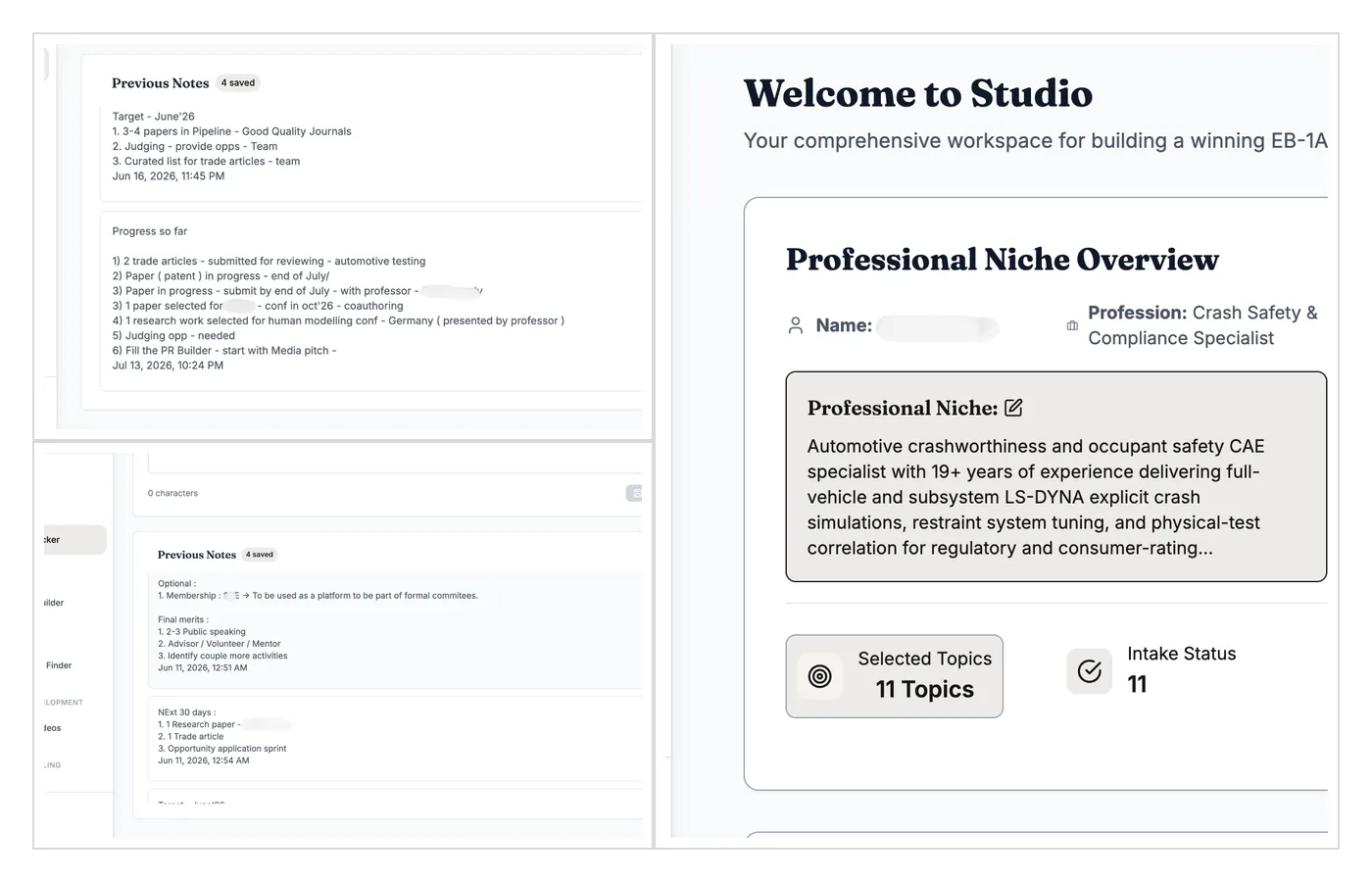
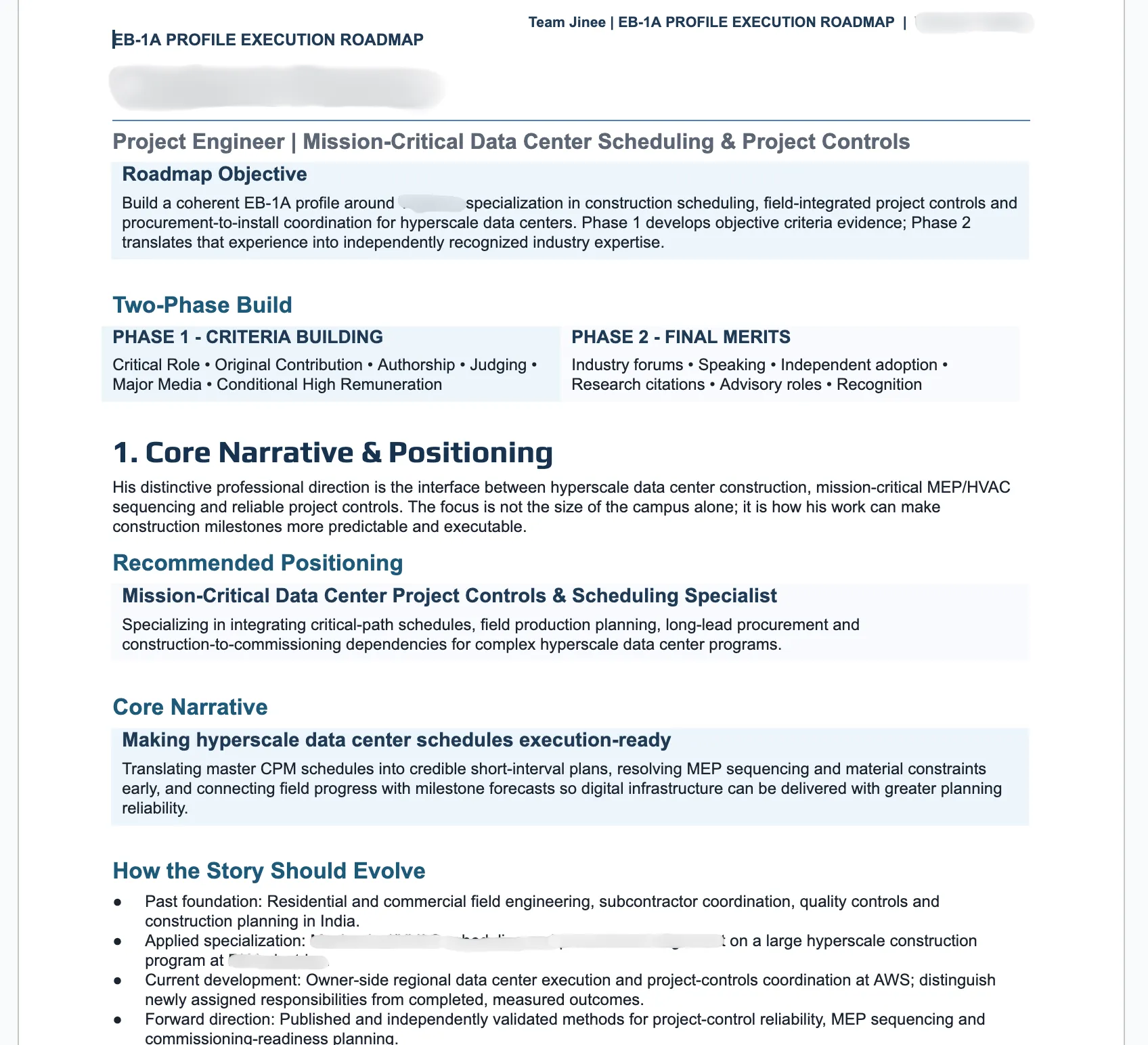
That can include identifying existing strengths, developing a roadmap, researching legitimate opportunities, facilitating mentorship, supporting research and publications, discovering speaking or judging opportunities, organizing evidence, documenting professional impact, and helping clients remain accountable to the strategy.
When those functions work together appropriately, the attorney doesn’t have to become a career-development platform, and the profile-development company doesn’t have to pretend to be a law firm.
03
Why This Matters for Attorneys
Imagine an attorney evaluates a professional and determines that the person has a potentially strong background but needs significantly more independent evidence.
Perhaps the person has made an important technical contribution.
But its significance hasn’t been properly documented.
Maybe the individual needs independent experts who can credibly speak to the work.
Maybe the professional has considerable expertise but almost no external visibility.
Or perhaps several potential areas exist, but the professional needs to spend the next year developing them coherently.
An attorney can identify those weaknesses.
But helping someone execute hundreds of small professional-development steps over the following year can require an entirely different infrastructure.
Researching relevant conferences.
Finding legitimate judging opportunities.
Tracking professional activities.
Supporting publication development.
Helping organize research collaborations.
Identifying organizations.
Maintaining evidence.
Tracking progress.
Providing mentorship.
Following up month after month.
Jinee’s model is built around that longer development cycle.
This distinction becomes particularly important because talent-based immigration can create the wrong incentives.
Someone learns that judging may be relevant evidence and starts searching for the fastest possible way to “get judging.”
Someone learns about authorship and decides they need five articles.
Someone hears that media coverage can matter and begins looking for somewhere to pay for an article.
That can turn professional development into credential collection.
Jinee’s stated philosophy takes a different approach.
The company argues that activities should grow out of the professional’s actual expertise.
If someone has spent years solving a particular engineering problem, perhaps that expertise can become the basis for meaningful authorship.
That authorship may lead to speaking.
Speaking and professional participation may expand the individual’s network.
Growing expertise and recognition may eventually result in legitimate invitations to judge or review other people’s work.
Research may create independent validation.
And the individual’s existing professional contributions may become better documented.
In that model, the objective isn’t to acquire unrelated criteria.
It’s to develop a coherent body of work.
04
Why Evidence Quality Matters
Immigration cases ultimately depend on evidence, not simply claims.
For EB-1A, satisfying the initial evidentiary criteria is not necessarily the end of the analysis; USCIS evaluates the evidence as a whole in determining whether the required level of acclaim has been demonstrated. (USCIS)
That makes documentation important.
It’s one thing to say:
“I built an important system.”
It’s another to establish what the person personally built, how widely it was deployed, what measurable impact it produced, why the contribution was significant, and whether credible independent sources can validate that significance.
Similarly, saying someone is an industry expert is different from showing that independent organizations invite that person to speak, evaluate work, collaborate, publish, or otherwise contribute because of that expertise.
This is another area where profile development and legal representation can complement each other.
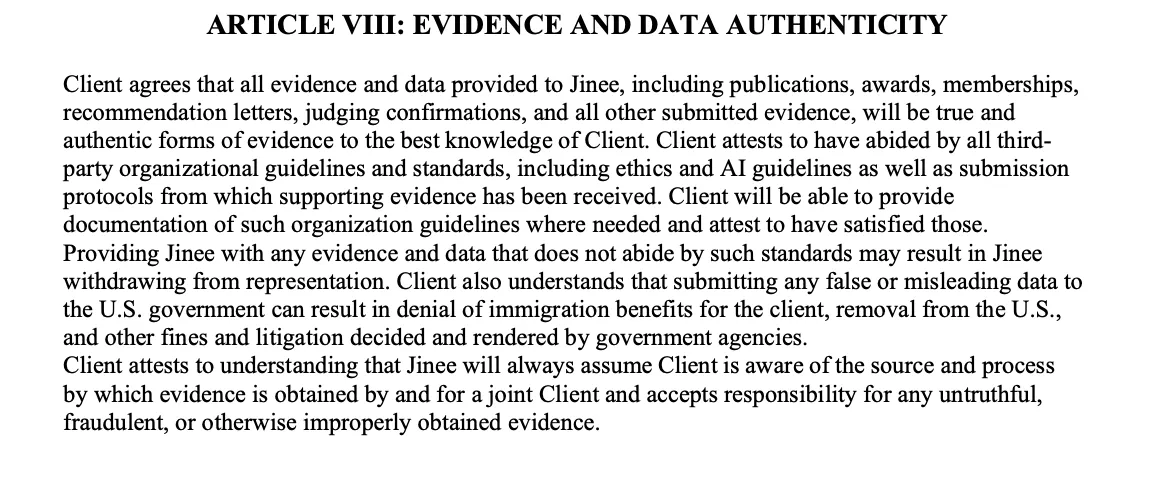
The profile-development process helps create and preserve a stronger factual record.
The attorney determines how, or whether, that record supports a particular legal argument.
05
Jinee Doesn’t Decide Immigration Eligibility
This boundary is important.
Jinee can help professionals assess their accomplishments from a profile-development perspective, build a professional roadmap, and organize evidence.
But legal eligibility is a legal question.
The attorney should ultimately determine whether someone’s evidence satisfies the requirements of a particular immigration classification and how that evidence should be presented.
That separation can also create a useful check within the process.
A profile-development team may believe an accomplishment is compelling.
An attorney may disagree.
The attorney may identify a legal weakness that requires better documentation.
Or the attorney may determine that an activity Jinee considered useful isn’t particularly important to the eventual petition.
That feedback can then influence the development roadmap.
06
What Collaboration Can Look Like in Practice
A simplified client journey might look something like this:
A professional begins with an assessment of their existing career and accomplishments.
Potential strengths and gaps are identified.
A development roadmap is created around the individual’s actual expertise.
Over the following months, the professional works on meaningful activities and contributions.
Jinee provides research, infrastructure, mentorship, opportunity discovery, accountability, and evidence organization around that work.
As the profile develops, immigration counsel can evaluate the evidence from a legal perspective.
Attorney feedback can identify remaining weaknesses.
The professional continues developing the profile where appropriate.
When immigration counsel believes there is an appropriate filing strategy, the legal team handles the petition and filing.
The exact process varies by professional and attorney, but the underlying division of responsibilities remains important.
Jinee helps develop the professional profile.
The attorney handles the legal case.

07
Why Would a Law Firm Refer Someone to a Profile-Development Company?
08
Why Would Jinee Send Someone to an Attorney?
The relationship also works in the opposite direction.
There comes a point where profile development stops being the primary question.
Someone may want to know:
Am I legally eligible?
Which classification should I pursue?
Should I file O-1A, EB-1A, or NIW?
How should a particular piece of evidence be characterized legally?
What are the risks of filing now?
What legal argument should be made?
Those questions belong with immigration counsel.
A responsible profile-development company should recognize that boundary rather than attempting to answer every immigration question itself.
09
The Relationship Should Also Create Accountability
Another common question is why an O-1A or EB-1A development program might take many months rather than several weeks.
There is another advantage to separating the two functions.
Each side can challenge the other.
Jinee may help a client build something it considers significant.
An attorney can ask:
“Where is the independent evidence?”
An attorney may identify a potentially useful criterion.
The development team can ask:
“What would the client have to genuinely accomplish over the next year for this to become meaningful?”
The client remains responsible for actually performing the work.
And ultimately, government adjudicators decide whether the legal requirements have been satisfied.
That creates several distinct layers instead of asking one organization to control the entire process.
The answer depends heavily on the starting profile.
Some professionals may already have substantial evidence and primarily need organization, documentation, or a few specific gaps addressed. Others may require significant professional development. Meaningful research takes time. Developing and demonstrating an original contribution can take time. Building a credible body of authorship takes time. Establishing enough expertise that independent organizations ask someone to judge or review other professionals’ work can take time. Building independent recognition takes time.
For this reason, Jinee’s development model can involve a longer-term roadmap rather than attempting to complete a predetermined immigration checklist as quickly as possible.
10
What Should Someone Look for in a Jinee Green Card Review?
Someone researching Jinee Green Card reviews should look beyond whether a reviewer simply says the experience was “good” or “bad.”
More useful questions include:
Did the client understand the difference between profile development and legal representation?
Was there an actual individualized strategy?
Did the client genuinely perform the activities attributed to them?
Were attorneys involved when legal questions arose?
Was evidence developed and documented over time?
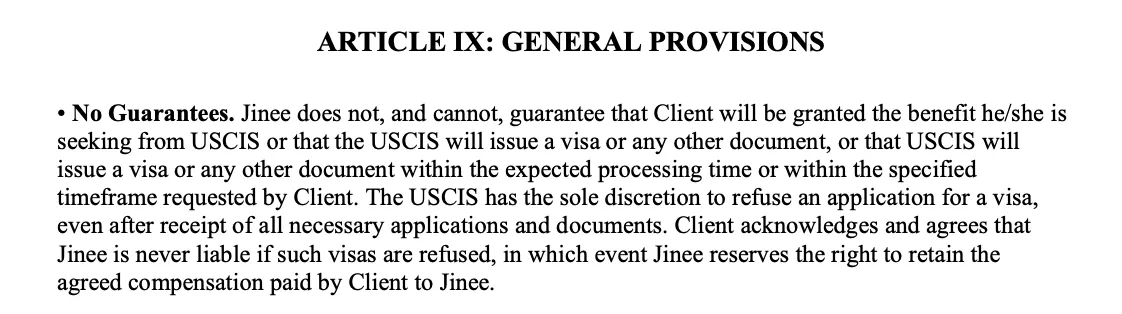
Did the client understand that immigration approval was not guaranteed?
And did the process create professional value beyond simply checking immigration criteria?
Those questions provide considerably more information about how the model actually operates.
A Different Division of Labor in Talent-Based Immigration
The broader idea behind Jinee’s law-firm relationships is relatively straightforward.
Immigration attorneys are trained to practice immigration law.
Professionals are responsible for creating the actual accomplishments underlying their careers.
Jinee is attempting to build the infrastructure between those two points.
The professional does the work.
Jinee helps the professional develop, externalize, organize, and document that work.
The attorney determines how that evidence fits within immigration law and handles the legal petition.
None of those roles completely replaces another.
When the system works properly, they complement one another.
And for professionals considering pathways such as O-1A or EB-1A, that distinction may be more important than simply asking:
“Who can file my case?”
The better question may be:
“Am I ready to file a strong case in the first place?”
And if the answer is “not yet,” the work that happens before filing can be just as important as the filing itself.
Internal evidence plan before publishing
For this one, I would prioritize quality over quantity. We don’t need 15 screenshots.
The five strongest assets would be: an attorney video explaining why profile development matters; one real attorney → Jinee referral where the person wasn’t ready to file; one anonymized 12–24 month client roadmap; one attorney-feedback → Jinee-development → attorney-reassessment journey; and one piece of objective evidence establishing each law-firm relationship we actually name.
If we can substantiate those five, this becomes a very strong “Jinee Green Card reviews” article because the credibility is coming from attorneys, documents, workflows, and actual case-development history rather than Jinee telling the reader that law firms trust it.
11
Frequently Asked Questions
Is Jinee Green Card an immigration law firm?
No. Jinee Green Card works on the profile-development side of talent-based immigration. Legal advice, eligibility decisions, petition strategy, and filings are handled by qualified immigration attorneys.
What is the difference between Jinee Green Card and an immigration attorney?
An immigration attorney answers the legal question: how should a case be evaluated and presented under immigration law? Jinee answers the development question: what can a professional genuinely build, contribute, and document over the next 6 to 24 months to strengthen their profile?
Why would an immigration attorney refer a client to Jinee Green Card?
Sometimes an attorney sees strong potential in a professional who isn’t ready to file yet. Instead of only saying “come back when your profile is stronger,” the attorney can refer them to a team that provides the roadmap, opportunities, mentorship, and evidence support needed to build that profile.
Does Jinee Green Card decide if I'm eligible for O-1A, EB-1A, or EB-2 NIW?
No. Jinee can assess your accomplishments from a profile-development perspective and identify gaps. Whether your evidence meets the legal requirements of a specific visa category is a legal question for your immigration attorney, who also prepares and files the petition.
Does Jinee Green Card guarantee approval?
No. Immigration decisions are made by government adjudicators, and legal strategy is decided by immigration counsel. No legitimate profile-development company can guarantee an approval.