
Does a Fixed F-1 End Date Change When You Should Start EB-1A or O-1A?
Starting September 15, 2026, F-1 students no longer get an open-ended stay while enrolled. A fixed end date now lands on every I-94 record, and that changes how early Jinee Green Card recommends F-1 students start building an EB-1A or O-1A case.
Team Jinee
Extraordinary Ability. Precisely Positioned.

August 2026

4 min read
93%
Jinee approval rate
30 days
New F-1 departure grace period
4 years
Maximum fixed F-1 admission period
2026 standard
USCIS/DHS aligned
On This Page
Why Is the F-1 End Date No Longer Open-Ended?
What Does This Change About Starting EB-1A or O-1A?
Why Choose Jinee Green Card
FAQs
References
Yes, a fixed F-1 end date changes your timing, though not your eligibility. DHS has ended “duration of status” for F-1 students effective September 15, 2026, replacing it with a fixed admission period tied to the Form I-20, capped at four years. The evidentiary standard for EB-1A and O-1A stays the same. What changes is how much runway is left to build and file before that fixed date arrives.
For more than three decades, F-1 students were admitted for “duration of status,” meaning there was no set expiration date on their stay as long as they kept meeting program requirements. A final rule published by DHS on July 17, 2026 ends that framework. From September 15, 2026, every F-1 student gets a fixed admission period tied to the program length on their Form I-20, capped at four years, plus a 30-day arrival window and a 30-day departure window. The rule applies to students already in the US, not just new arrivals.
According to Jinee Green Card, “Students used to treat the F-1 timeline as flexible. That flexibility is gone. A fixed end date means the decision about when to start an EB-1A or O-1A case can’t be pushed to the last semester anymore. The standard USCIS applies hasn’t changed, but the amount of time available to meet it has shrunk.”
Jinee Green Card notes that this shift changes when an O-1A change of status needs to be filed. It now has to go in with a real buffer before the fixed admission date runs out, not in the final weeks of the old 60-day grace period.

A fixed F-1 end date doesn’t lower or raise the EB-1A or O-1A evidentiary bar. It just makes it more costly to start building that evidence late.
01-
Why Is the F-1 End Date No Longer Open-Ended?
DHS published the final rule ending duration of status for F, J, and I nonimmigrants on July 17, 2026. It takes effect September 15, 2026, and eliminates the framework that let F-1 students remain in the US indefinitely so long as they maintained their program.
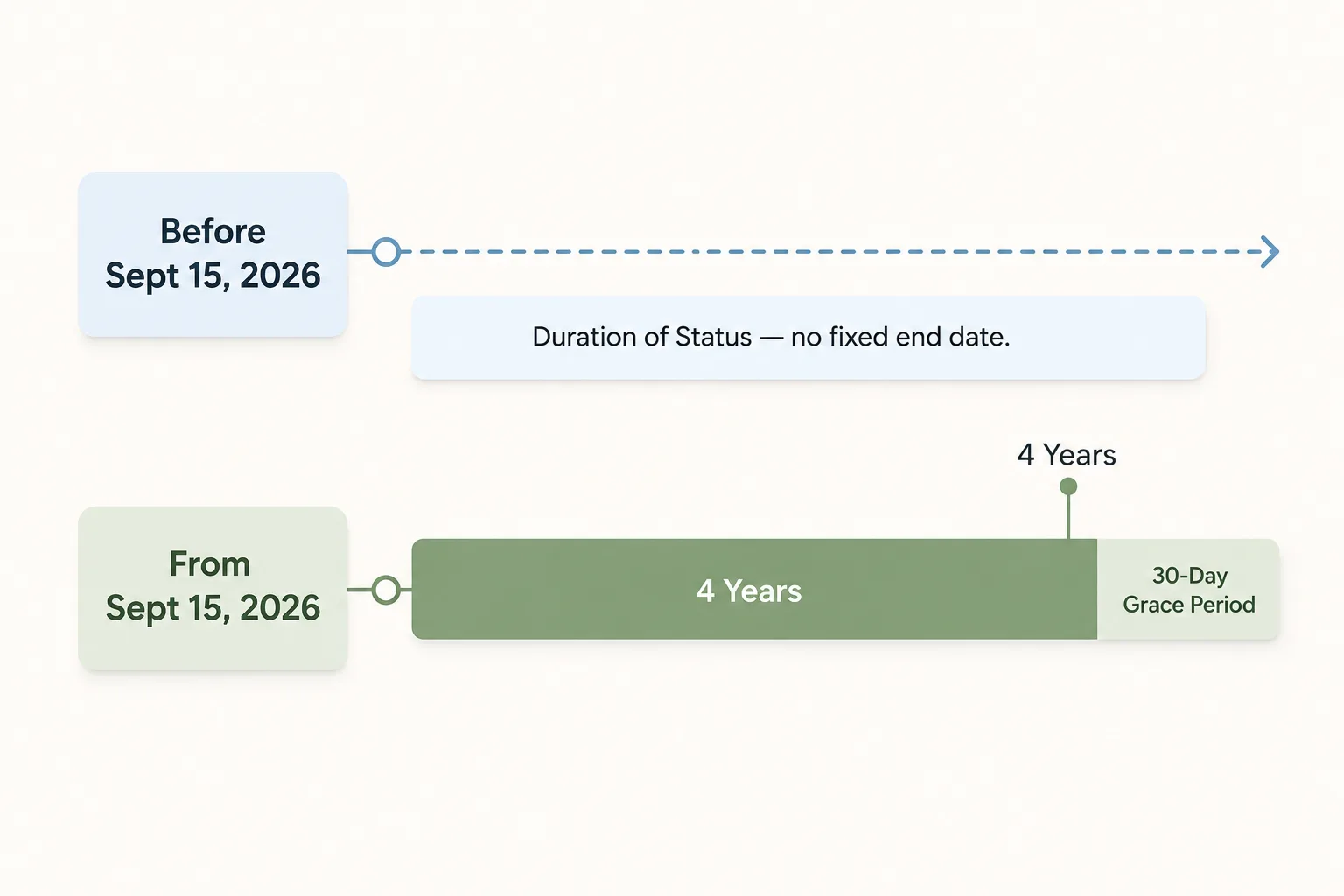
A fixed admission period replaces the open-ended one:
From the effective date, F-1 students are admitted for a fixed period tied to their Form I-20 program length, capped at four years, plus a 30-day period for arrival and a separate 30-day period for departure. The fixed end date is reflected as a specific admit-until date on Form I-94.
Anyone needing more time must file for an extension:
Students on OPT or STEM OPT, or in longer programs like a PhD, now have to file an Extension of Stay application with USCIS before their fixed admission period lapses, or leave the US and re-enter to get a new period of admission.
The departure grace period is shrinking:
The window to prepare for departure, transfer schools, or change status once a program or OPT period ends is being cut from 60 days to 30 days.
The rule applies retroactively to current students:
Students already in the US under duration of status as of September 15, 2026 will have their status transitioned to the new fixed-period framework, so this isn’t limited to new arrivals.
Students weighing an O-1A change of status can review our extraordinary-ability profile breakdown of how USCIS evaluates evidence before that filing.
02-
What Does This Change About Starting EB-1A or O-1A?
The evidentiary standards for EB-1A and O-1A are unchanged by this rule. What changes is the planning window around them, and that affects when the evidence-building work should actually begin.
O-1A can be filed as a change of status before the fixed date arrives:
An O-1A petition can be filed while a student is still in valid F-1 status, including during OPT or STEM OPT. With a hard admission end date and only a 30-day grace period after it, filing needs a real buffer, not a last-minute submission timed to the old 60-day window.
EB-1A itself doesn't require a specific nonimmigrant status to file:
EB-1A is a self-petition filed on Form I-140 with USCIS and doesn’t depend on holding a particular visa status at filing. Where status matters is later, if the plan includes adjustment of status inside the US, which does require being in a valid status.
A fixed clock makes early evidence-building more valuable, not less achievable:
The four-year cap and shorter grace period mean less room to decide “what’s next” only once a program is ending. Students who start documenting awards, publications, leading roles, and other EB-1A or O-1A criteria earlier in their F-1 timeline have more options when the fixed date actually approaches.
Sequencing the two routes now needs to happen sooner:
Some students pursue O-1A first as a bridge, then EB-1A once the evidence record is stronger. Others go straight to EB-1A. Deciding which sequence fits is a conversation worth having well before the fixed admission date, not in the final months of it.
A recent O-1A approval shows how early profile-building made a difference for an applicant transitioning out of F-1 status.

FREE EVALUATION
Get a free case evaluation from our team. We’ll map your fixed admission date against your evidence, and recommend a filing sequence that fits your timeline.
03-
Why Choose Jinee Green Card?
At Jinee Green Card, we’ve helped over 500 professionals secure approvals at a 93 percent rate, across EB-1A, O-1A, and EB-2 NIW. The team includes immigration attorneys and an ex-USCIS officer who has adjudicated extraordinary-ability petitions from inside the agency. Most F-1 students reach us close to their program end date. The earlier conversation is the one that gives an O-1A or EB-1A case the strongest evidence record before a fixed deadline forces the decision.
04-
Frequently Asked Questions
What is the new F-1 fixed admission period rule?
Starting September 15, 2026, F-1 students will no longer be admitted for “duration of status.” Instead, they’ll get a fixed admission period based on the program length on their Form I-20, capped at four years, plus a 30-day arrival window and a 30-day departure window.
Has the F-1 grace period changed?
Yes. The post-completion grace period is being reduced from 60 days to 30 days once a student’s program or authorized OPT period ends.
Can I file O-1A while still on F-1 or OPT status?
Yes. O-1A can be filed as a change of status while an applicant is still in valid F-1 status, including during OPT or STEM OPT, without waiting for the grace period to begin.
Does EB-1A require a specific visa status to file?
No. EB-1A is a self-petition filed on Form I-140 with USCIS and doesn’t itself require a particular nonimmigrant status. Status matters more for a later adjustment of status filing.
Does the fixed F-1 end date change EB-1A or O-1A eligibility requirements?
No. The evidentiary standards for both categories are unchanged. What changes is how much time is left to build and file a strong case before the fixed admission period runs out.
05-
References

DHS/SEVP — Final Rule: Fixed Time Period of Admission and Extension of Stay (FAQ):
USCIS — O-1 Visa: Individuals with Extraordinary Ability or Achievement:
Disclaimer
This blog is for informational purposes only and does not constitute legal advice. Consult a licensed immigration attorney for guidance specific to your case.
Understand where your profile stands before you file.