
EB-2 NIW for Financial Analysts, Quants, and Economists
Financial analysts, quantitative researchers, and economists can qualify for EB-2 NIW, but job title alone is not enough. USCIS evaluates the applicant’s proposed endeavor under the three-part Matter of Dhanasar framework. The key question is whether the proposed work has substantial merit and national importance, whether the applicant is well positioned to advance it, and whether waiving the job offer and labor certification requirements benefits the United States. Jinee Green Card regularly works with finance professionals who assume this category is built only for scientists and researchers, which isn’t the case.
Team Jinee
Extraordinary Ability. Precisely Positioned.

September 2026

8 min read
93%
Jinee approval rate
~45 business days
Premium processing decision time for I-140
3 prongs
Substantial merit, positioning, and balancing under Dhanasar
2026 standard
USCIS aligned
On This Page
The Dhanasar Test, Applied to Finance
What “National Importance” Looks Like for This Field
What Evidence Actually Works
What NIW Doesn’t Solve
Why Choose Jinee Green Card?
FAQs
References
EB-2 NIW has no official list of qualifying occupations, and USCIS evaluates each petition on the applicant’s proposed endeavor rather than their job title. Financial analysts, quantitative researchers, and economists can build strong cases when their work connects to economic growth, financial stability, systemic risk management, or the broader financial infrastructure the U.S. economy depends on.
Most employment-based green card categories are built around a specific job, a specific employer, and a specific wage. EB-2 NIW works differently. There’s no petitioner, no labor certification, and no list of occupations USCIS checks an applicant’s title against. What gets evaluated is the proposed endeavor itself, measured against the three-prong Dhanasar standard, not the job description on a business card.
According to Jinee Green Card, “Finance professionals often assume this category was written for lab researchers and academics. It wasn’t written for any occupation in particular. The Dhanasar test asks whether the proposed work matters at a national level and whether this specific applicant is positioned to carry it out. An economist’s policy research or a quant’s risk model can satisfy that just as directly as a scientist’s published findings can.”
At Jinee Green Card, our NIW case reviews for finance professionals start by identifying the actual proposed endeavor buried inside someone’s day-to-day work, since that’s usually where the strongest Dhanasar argument is hiding, not in a job title or years of tenure.

01-
Why Finance Professionals Overlook NIW?
NIW discussions tend to center on researchers and STEM fields, and for good reason. A large share of successful petitions come from academia and applied science. But the underlying legal standard, established by Matter of Dhanasar in 2016, was never written to favor one industry. It asks whether the proposed work has substantial merit and national importance, whether the applicant is well positioned to advance it, and whether it benefits the U.S. to waive the standard job offer and labor certification requirements.
Financial analysts, quantitative researchers, and economists are frequently well positioned to meet all three prongs. They often just haven’t framed their work in the language USCIS is looking for. A quant who builds risk models used across a major institution, or an economist whose research shapes policy discussion, has the kind of impact NIW asks for. The gap is usually in documentation, not qualification.
Applicants weighing NIW against other self-petitioned routes can also review our related guide on minimum salary requirements for EB-1A or NIW, since compensation questions come up often in finance-sector cases.
02-
The Dhanasar Test, Applied to Finance
Every NIW petition has to satisfy three prongs:
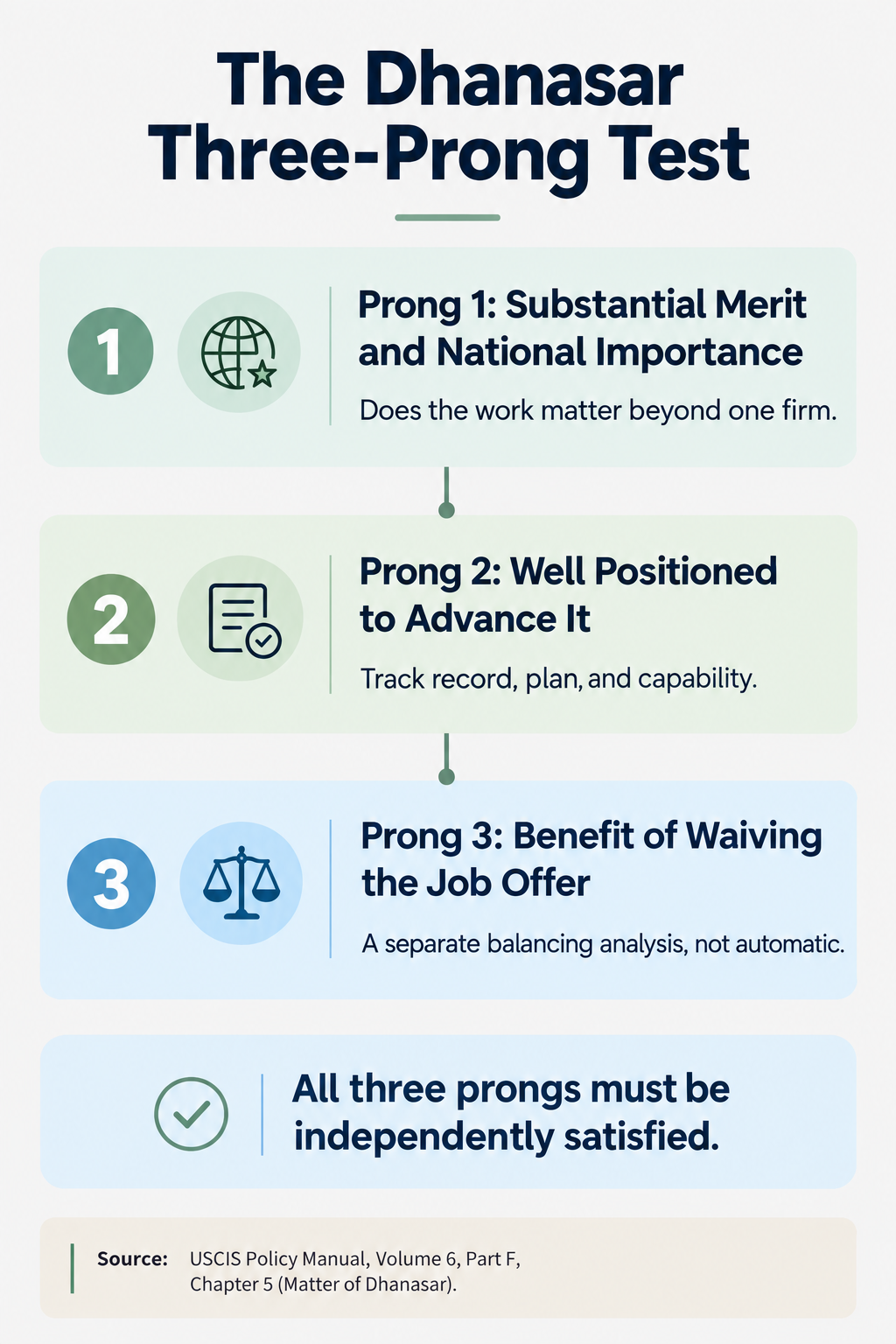
Prong 1: Substantial merit and national importance. The proposed work needs to matter at a national level, not just within a single firm. For finance professionals, this generally means connecting the work to something broader than internal performance: financial stability, systemic risk, market efficiency, capital access, or economic policy.
Prong 2: Well positioned to advance the endeavor. This is where an applicant’s track record matters: education, prior achievements, a specific plan, and evidence that the applicant, specifically, is capable of carrying out the proposed work, not just someone in a similar role.
Prong 3: Benefit of waiving the job offer requirement. Prong 3 asks whether, on balance, it would benefit the United States to waive the job offer and labor certification requirements. A strong showing under Prongs 1 and 2 can support this argument, but Prong 3 still requires its own analysis.
In practice, if Prongs 1 and 2 are genuinely strong, Prong 3 tends to follow more naturally. The harder cases are usually the ones where the proposed work reads as narrow or purely internal to one company.
03-
What “National Importance” Looks Like for This Field
This is the prong finance professionals most often struggle to frame correctly, since day-to-day work in the field doesn’t always sound “national” on its face. A few angles that tend to work, when properly documented:
Systemic risk and financial stability: work that touches how institutions measure, manage, or report risk in ways that extend beyond one firm’s internal exposure.
Economic research with policy relevance: analysis that’s been cited, referenced, or used by policymakers, regulators, or industry bodies, not just published internally.
Capital markets and financial infrastructure: contributions to systems, models, or platforms whose broader significance and adoption can be independently documented, rather than assumed from the nature of the work itself.
Fintech and quantitative innovation: work connecting to critical and emerging technology priorities, particularly where algorithmic trading, financial AI, or payment infrastructure intersects with broader economic function.
Financial inclusion and access: work expanding access to credit, banking, or investment tools in underserved markets. As with any proposed endeavor, this still has to be independently documented and connected to a national-level effect; it isn’t a category USCIS pre-approves.
The proposed endeavor, not simply the applicant’s occupation, must have national importance. None of the categories above qualify automatically; each still has to be documented on its own facts.
A strong NIW case in finance rarely comes from claiming to be the best analyst at one firm. It comes from showing the work would matter to the country even if that firm never existed.
Job title ≠ proposed endeavor.
USCIS does not determine national importance simply from your occupation. A financial analyst, economist, or quant can perform work that is highly valuable to one employer without demonstrating that the specific proposed endeavor has national importance. The case becomes stronger when the proposed work is clearly defined and its broader implications can be documented.
04-
What Evidence Actually Works
A few categories of evidence come up repeatedly in strong finance-sector NIW cases:
Published research or analysis that’s been cited by other economists, analysts, or institutions, not just internal reports.
Models or frameworks adopted beyond one employer, particularly risk models, valuation methods, or forecasting tools used industry-wide or by regulators.
Recommendation letters from independent experts outside the applicant’s own organization, including academics, senior economists at other institutions, or regulators who can speak credibly to the work’s broader significance.
Documented policy influence, including testimony, advisory roles, or research referenced in regulatory or legislative discussions.
Advanced credentials paired with a specific, well-defined endeavor. A CFA, PhD, or equivalent advanced degree strengthens Prong 2, but only when paired with a concrete plan for the proposed work, not a general resume.
05-
What NIW Doesn’t Solve
It’s worth being direct about the limits here:
It doesn’t remove visa bulletin backlogs. Employment-based backlogs have remained elevated across categories through 2026, so even an approved NIW petition still depends on priority date movement before a green card is actually issued.
It doesn’t work for every finance role. Strong internal performance, without evidence of impact beyond one employer, generally doesn’t meet Prong 1 on its own.
It isn’t fast. Regular I-140 processing for NIW currently runs well over a year, and can extend considerably longer depending on the service center and case volume at the time of filing. Premium processing, where available, brings adjudication down to about 45 business days for an additional fee. Current processing times can be checked directly on USCIS’s case processing times tool, since they shift regularly.

FREE EVALUATION
Get a free case evaluation from our team. We’ll help you identify whether your track record already supports Prong 1 and Prong 2, and what’s missing if it doesn’t yet.
06-
Why Choose Jinee Green Card?
At Jinee Green Card, we’ve helped more than 500 professionals get approved, at a 93 percent success rate, across EB-1A, O-1A, and EB-2 NIW. We’ve built NIW cases specifically for economists, quantitative researchers, and financial analysts whose impact wasn’t obvious on paper until it was properly documented and framed against the Dhanasar standard. Our immigration attorneys know how to translate financial and quantitative work into the kind of national importance narrative USCIS actually looks for, and our ex-USCIS officer has reviewed exactly what separates a compelling NIW petition from one that reads as generic professional achievement.
07-
Frequently Asked Questions
Can financial analysts actually qualify for EB-2 NIW?
Yes. NIW has no official occupation list, and financial analysts qualify when their work demonstrates national importance under the Dhanasar test, typically through impact on financial stability, risk management, or capital markets that extends beyond a single employer.
Do I need a PhD to qualify for NIW as an economist or quant?
Not necessarily. The base EB-2 requirement can be met through an advanced degree or through exceptional ability, which doesn’t require a doctorate. A master’s degree with several years of progressive experience can also satisfy the underlying EB-2 threshold, though a strong plan for the proposed endeavor still matters more than the credential alone.
What's the difference between NIW and EB-1A for finance professionals?
NIW requires meeting the three-prong Dhanasar test around national importance and positioning, while EB-1A requires meeting a higher extraordinary ability standard across specific regulatory criteria. Many finance professionals find NIW more attainable, though some with strong independent recognition may qualify for either.
How long does the EB-2 NIW process take in 2026?
Regular I-140 processing for NIW currently runs well over a year and varies by service center, so it’s worth checking USCIS’s live processing times tool for the current range rather than relying on a fixed number. Premium processing can bring adjudication down to about 45 business days for an additional fee. Even after I-140 approval, visa availability still depends on the visa bulletin and current backlog conditions.
Does my work need to be published to qualify for NIW?
No, though published, cited work strengthens a case considerably. Evidence can also include adopted models or frameworks, documented policy influence, recommendation letters from independent experts, and demonstrated impact even without formal academic publication.
08-
References

USCIS Policy Manual — National Interest Waivers
USCIS — Check Case Processing Times
Disclaimer
This blog is for informational purposes only and does not constitute legal advice. Consult a licensed immigration attorney for guidance specific to your case.
Understand where your profile stands before you file.