
What Is the EB-1A Visa Bulletin and Priority Date Backlog for Indian Applicants?
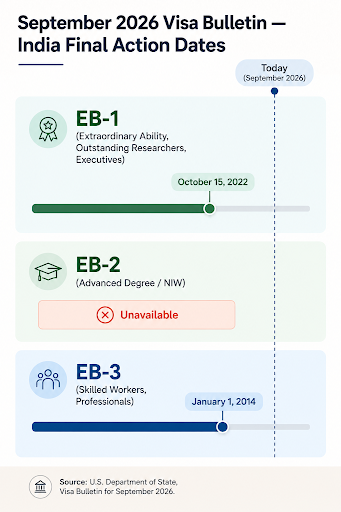
The EB-1A Visa Bulletin entry is the monthly figure the U.S. Department of State publishes showing how far back an India-born applicant’s priority date needs to be for a green card to move forward. As of the September 2026 Visa Bulletin, that figure for EB-1 India sits at October 15, 2022, unchanged from the prior month, while EB-2 India has gone fully unavailable and EB-3 India remains at January 2014. Jinee Green Card tracks this bulletin monthly for exactly this reason.
Team Jinee
Extraordinary Ability. Precisely Positioned.

October 2026

7 min read
83%
Jinee approval rate
October 15, 2022
EB-1 India Final Action Date (Sept 2026)
Unavailable (U)
EB-2 India status (Sept 2026)
January 1, 2014
EB-3 India Final Action Date (Sept 2026)
On This Page
What Does the September 2026 Visa Bulletin Show for EB-1 India?
How Does This Compare to EB-2 and EB-3 India?
Final Action Dates vs. Dates for Filing: Which One Applies?
Why Choose Jinee Green Card?
FAQs
References
Every month, the Department of State publishes the Visa Bulletin, showing which priority dates are currently being processed for each employment-based category and country. For India, EB-1 has its own separate cutoff, distinct from EB-2 and EB-3, because it draws from a different statutory allocation. As of the September 2026 Visa Bulletin, EB-1 India’s Final Action Date is October 15, 2022, meaning applicants with an earlier priority date can move forward, while EB-2 India is currently unavailable for the rest of the fiscal year, and EB-3 India sits at January 2014.
The gap between EB-1 India and the other employment-based categories has been widening rather than closing. Both EB-2 and EB-3 India draw from the same 7% per-country limit as EB-1, but far higher demand in those categories, largely from PERM-based sponsorship, has pushed their cutoffs back by a decade or more compared to EB-1’s roughly three-year gap.
According to Jinee Green Card, “The September bulletin is a reminder that EB-1 India isn’t static. It held steady this month, but the bulletin itself flags that high demand could force it unavailable before the fiscal year ends if India’s pro-rated limit is reached. Applicants shouldn’t assume this date will keep sitting where it is.”
At Jinee Green Card, our EB-1A case reviews for India-born applicants start by checking where a client’s existing priority date sits against the current bulletin, since that comparison often determines whether pursuing EB-1A changes the timeline meaningfully or not.

EB-1 India moved from an obscure line in a government bulletin to a three-year wait. EB-2 India moved from a decade-plus wait to no availability at all this fiscal year.
01-
What Does the September 2026 Visa Bulletin Show for EB-1 India?
According to the September 2026 Visa Bulletin, published by the Department of State on August 10, 2026, the Final Action Date for EB-1 India is October 15, 2022. This date has not moved since the August bulletin, meaning applicants with a priority date earlier than October 15, 2022 remain eligible to have their case finalized, while those with later priority dates continue waiting.
The bulletin also flags a specific risk for EB-1 India directly: it notes that high demand and number use in the EB-1 category could force USCIS to make the category unavailable before the fiscal year ends, if India’s pro-rated limit within EB-1 is reached first. That warning has appeared in recent bulletins and reflects real volatility, not a routine disclaimer.
For context on how these dates are set, the per-country limit for FY2026 is fixed at 7% of the combined annual family and employment preference limits, which works out to roughly 28,862 visas (or about 29,136 including carryover provisions), regardless of how much demand actually exists from any single country.
Applicants weighing whether EB-1A actually shortens their timeline can review our related breakdown on Indian IT professionals and the green card backlog for a deeper look at how this bulletin translates into real wait times.
02-
How Does This Compare to EB-2 and EB-3 India?
The gap between EB-1 India and the other employment-based categories widened further in the September 2026 bulletin. EB-2 India’s Final Action Date is now listed as “U,” meaning unavailable, since demand and number use in that category have already exceeded what the FY2026 allocation can support for the remainder of the year. EB-3 India remains at January 1, 2014, unchanged from the prior bulletin.
That puts the practical gap between EB-1 and the other categories at roughly a decade or more. An applicant with a 2022 priority date under EB-1 can move forward now. An applicant with a 2014 priority date under EB-3 can also move forward, but anyone with a later EB-2 India priority date currently has no path forward this fiscal year at all, regardless of date, since the category is unavailable rather than simply delayed.
03-
Final Action Dates vs. Dates for Filing: Which One Applies?
The Visa Bulletin actually publishes two separate charts each month: Final Action Dates and Dates for Filing. USCIS decides monthly which chart applicants adjusting status inside the US must use, and for September 2026, USCIS has confirmed that employment-based applicants must use the Final Action Dates chart, the same one referenced above (October 15, 2022 for EB-1 India, unavailable for EB-2 India, January 2014 for EB-3 India).
The Dates for Filing chart shows different, generally later dates, since it reflects when USCIS anticipates enough visas will become available to begin processing, rather than when a visa is actually ready to be issued. For September 2026, that chart shows December 1, 2023 for EB-1 India and January 15, 2015 for both EB-2 and EB-3 India. Confusing the two charts is a common mistake: only the chart USCIS designates for that month determines whether an applicant can actually file.

FREE EVALUATION
Not sure how your priority date lines up with the current EB-1 India cutoff, or whether EB-1A could shorten your timeline?
Get a free case evaluation from our team. We’ll walk through where your evidence and your existing priority date actually stand.
04-
Why Choose Jinee Green Card?
At Jinee Green Card, we’ve helped over 500 professionals get approved, at a 93% success rate, across EB-1A, O-1A, and EB-2 NIW. Our immigration attorneys track each month’s Visa Bulletin as part of standard case planning for India-born applicants, and our ex-USCIS officer has reviewed exactly how EB-1A petitions are adjudicated from inside the agency, separate from the visa number question entirely.
05-
Frequently Asked Questions
What is the EB-1 India priority date as of the September 2026 Visa Bulletin?
The Final Action Date for EB-1 India in the September 2026 Visa Bulletin is October 15, 2022, unchanged from August.
Why is EB-2 India listed as unavailable in September 2026?
Demand and number use in the EB-2 category have exceeded what the per-country allocation can support for the rest of FY2026, so the Department of State has marked EB-2 India “U” (unavailable) rather than listing a specific date.
Does the Visa Bulletin apply the same way to EB-1A specifically?
Yes. EB-1A falls under the Employment-Based First Preference (EB-1) category, so the EB-1 India Final Action Date applies to EB-1A petitioners the same way it applies to other EB-1 classifications, such as outstanding professors, researchers, and multinational executives.
Should I use the Final Action Dates chart or the Dates for Filing chart?
For September 2026, USCIS has specified that employment-based adjustment of status applicants must use the Final Action Dates chart, not the Dates for Filing chart, to determine when they can file.
Could the EB-1 India date retrogress again?
Yes. The September 2026 bulletin itself notes that high demand in the EB-1 category could force USCIS to make it unavailable before the fiscal year ends if India’s pro-rated limit is reached, so this date is not guaranteed to hold or keep advancing.
06-
References

U.S. Department of State — Visa Bulletin for September 2026
USCIS — Adjustment of Status Filing Charts from the Visa Bulletin
Disclaimer
Understand where your profile stands before you file.