
F-1 to O-1A to EB-1A: What Students Need to Know in 2026
Does filing an EB-1A petition put your F-1 or STEM OPT status at risk? That’s the question Jinee Green Card hears from STEM OPT students more than almost any other. Filing an EB-1A I-140 does not automatically terminate F-1 or STEM OPT status. However, F-1 is not a dual-intent classification, so immigrant-intent considerations can become important in situations such as applying for a new F-1 visa or seeking admission to the U.S. For most students, the real question isn’t simply whether EB-1A can be filed. It’s whether to pursue O-1A first, go straight for EB-1A, or keep building a profile before doing either.
Team Jinee
Extraordinary Ability. Precisely Positioned.

September 2026

4 min read
93%
Jinee approval rate
I-140 vs I-485
Where the real risk sits
F-1 → O-1A → EB-1A
A common student pathway
2026 standard
USCIS/DHS aligned
On This Page
Does Filing EB-1A Affect F-1/OPT?
So Where Is the Actual Risk?
Why O-1A May Come First for Some Students
O-1A → EB-1A: How the Strategy Works
When Should You Go Directly to EB-1A?
What Should You Avoid?
Why Choose Jinee Green Card?
FAQs
References
F-1, including OPT and STEM OPT, is not a dual-intent status. Filing Form I-140 for EB-1A does not, by itself, end that status. What changes as a case moves forward is how closely a student needs to manage travel, visa renewals, and any later adjustment of status. For many STEM OPT students, that’s exactly why O-1A enters the conversation before EB-1A does, not as a requirement, but as a way to secure a more stable work status while a stronger record is still being built.
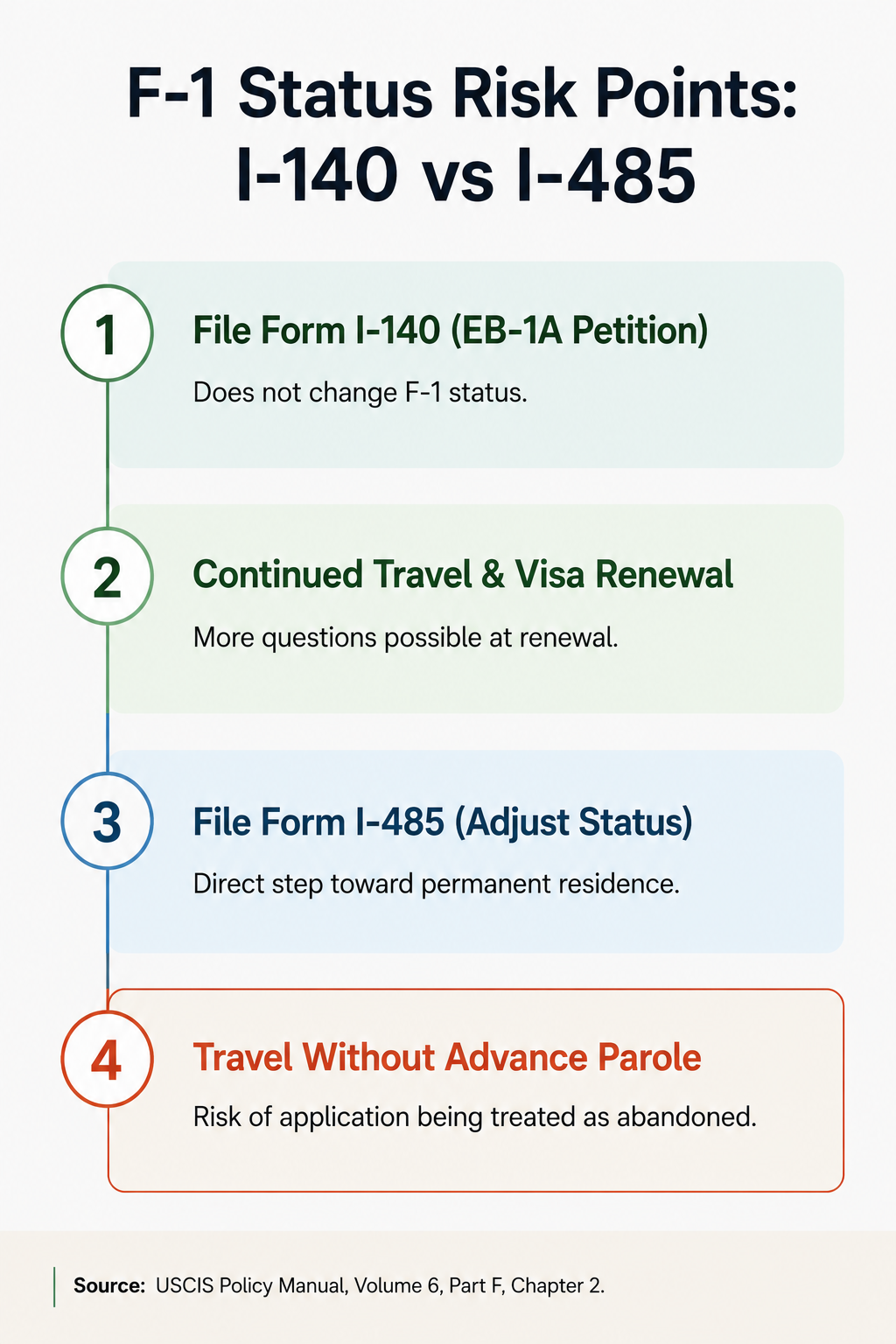
The confusion usually comes from mixing up two very different steps. Filing Form I-140 is USCIS confirming that someone meets the extraordinary ability standard, nothing more. Filing Form I-485 to adjust status is a direct, unambiguous move toward permanent residence, and that’s the step where F-1’s lack of dual intent actually starts to matter for travel and status maintenance.
According to Jinee Green Card, “Students often assume the I-140 is the risky step. It usually isn’t. The real planning conversation starts at I-485, and by then a student should already know whether O-1A was the right bridge or whether going straight to EB-1A always made sense for their record.”
At Jinee Green Card, our O-1A sequencing work for STEM OPT students maps the filing order against SEVIS status, travel plans, and visa renewal timing, rather than treating “can I file EB-1A” as a yes-or-no question detached from everything else going on in a student’s status.

Filing Form I-140 doesn’t end F-1 status. Filing Form I-485 is the step that actually requires careful planning around travel and maintaining status.
01-
Does Filing EB-1A Affect F-1/OPT?
Not automatically. Form I-140, the immigrant petition behind EB-1A, is evaluated on the strength of the applicant’s evidence, it does not require the applicant to hold a dual-intent visa, and filing it does not by itself terminate F-1 status or STEM OPT eligibility.
The distinction that matters here is between filing a petition and changing your status. An I-140 is USCIS recognizing that someone meets the extraordinary ability standard. It doesn’t, on its own, change what visa category a person is currently in or authorized to work under. Current USCIS practice treats the two as separate: an approved or pending I-140 doesn’t automatically convert or cancel F-1 status, and it doesn’t stop a DSO from continuing to authorize STEM OPT.
Where this gets more complicated is later in the process, specifically at the point where someone files Form I-485 to adjust status, or needs to renew a visa or re-enter the country. That’s covered next.
Students weighing their F-1 timeline more broadly can also review our breakdown of the F-1 fixed admission period rule and how it affects when to start either filing.
02-
So Where Is the Actual Risk?
The risk isn’t in the I-140 filing itself — it’s in what F-1’s nonimmigrant intent requirement means for everything around it.
F-1 requires students to demonstrate an intent to leave the U.S. once their study and authorized training end. This is different from H-1B or L-1, where dual intent is written into the statute, allowing someone to pursue a green card and hold nonimmigrant status at the same time without conflict. F-1 doesn’t get that same statutory protection, so a few things need closer attention once an EB-1A case is in motion:
Travel and visa renewal: A student who’s filed I-140 can generally continue traveling on F-1 terms, but a consular officer may ask more questions about long-term plans at a renewal interview than they would otherwise.
I-485 is a different stage entirely. Adjustment of status is a far more direct and unambiguous step toward permanent residence than I-140 is. Once I-485 is filed while still relying on F-1 status, students need to think carefully about maintaining status and about travel — leaving the country without Advance Parole at that stage can risk the application being treated as abandoned.
Conduct shortly after entry matters. State Department guidance applies scrutiny when a person’s actions shortly after being admitted look inconsistent with the intent they represented at the time of entry. This is about potential misrepresentation from inconsistent conduct — it isn’t an automatic bar on filing an I-140, but it’s a reason to build a documented timeline rather than filing immediately after a fresh entry or a STEM OPT approval.
| Status / Filing | What It Means |
|---|---|
| F-1 / OPT | Nonimmigrant status; not a dual-intent category |
| EB-1A I-140 | Immigrant petition; does not itself change F-1 status |
| O-1A | Temporary work status based on extraordinary ability |
| I-485 | Adjustment of status to permanent residence |
| H-1B / L-1 | Categories with statutory dual-intent protection |
03-
Why O-1A May Come First for Some Students?
This is often the more useful question than “can I file EB-1A” — because for a lot of STEM OPT students, the honest answer is that EB-1A isn’t the immediate need. The immediate need is a stable work status that doesn’t run out with OPT.
O-1A doesn’t carry the same statutory dual-intent provision that H-1B and L-1 do. But pursuing a green card isn’t inherently incompatible with holding O-1A status either — USCIS has long allowed O-1A holders to file and hold an approved I-140 without treating it as a violation, so the two can be sequenced strategically rather than treated as conflicting choices.
A simple way to think about which path fits:
- Need work status beyond OPT, and don’t yet have a strong enough record for EB-1A? O-1A is usually the more realistic next step.
- Already have strong, well-documented evidence of extraordinary ability? Filing EB-1A directly may make sense without needing O-1A as an intermediate step.
- Not sure the evidence supports either one yet? The right move is building the record further before filing anything, rather than filing early and hoping the case catches up.
04-
O-1A → EB-1A: How the Strategy Works
For students who go the O-1A route first, the good news is that the work doesn’t start over later. O-1A and EB-1A lean on substantially similar evidence — documented recognition, contribution, and field-level impact.
Evidence built for an O-1A petition — independent letters, documentation of impact, recognition from people outside the applicant’s own organization — generally carries forward into a later EB-1A filing rather than needing to be rebuilt from scratch. In practice, this means O-1A status can double as a runway: a student secures stable work authorization now, continues accumulating recognition and evidence during that period, and files EB-1A later once the record has genuinely caught up to the standard.
That compounding effect is really the strategic value of sequencing O-1A before EB-1A for students who aren’t quite ready — it isn’t just a stopgap, it’s evidence-building time that isn’t wasted.
05-
When Should You Go Directly to EB-1A?
Going straight for EB-1A tends to make sense for students who already have:
- Sustained recognition in their field, not a single strong achievement in isolation.
- Independent letters from senior figures with no direct professional tie to the applicant — the kind of evidence that carries weight at USCIS’s second-stage merits review.
- Documented impact that goes beyond internal contributions at one employer — adoption, citation, or influence that the broader field can point to.
- A clear narrative connecting the applicant’s specific contributions to outcomes the field recognizes, not just a list of credentials.
If most of that is already in place, adding an O-1A step first often just adds time without adding much strength to the case.
06-
What Should You Avoid?
A few patterns show up repeatedly in cases that run into trouble:
- Filing too early, especially right after entry or right after a STEM OPT approval, without a documented timeline behind it.
- Weak or generic evidence — letters or documentation that describe someone’s work in vague terms rather than specific, verifiable contributions.
- Ignoring travel and status maintenance once a case is in motion, particularly after I-485 is filed.
- Assuming O-1A functions as a formal dual-intent category the way H-1B does — it doesn’t, and treating it that way can lead to poor timing decisions.
- Poor sequencing — pursuing EB-1A before the evidence is ready, or skipping O-1A when it would have provided a more stable bridge.

FREE EVALUATION
Get your profile evaluated and understand which route makes sense right now and how that decision affects your longer-term green card strategy.
07-
Why Choose Jinee Green Card?
At Jinee Green Card, we’ve helped more than 500 professionals get approved, at a 93 percent success rate, across EB-1A, O-1A, and EB-2 NIW. For STEM OPT students specifically, the work usually starts with this exact question — O-1A first, EB-1A directly, or more time building the record — before it starts with drafting anything. Our immigration attorneys map the filing sequence against SEVIS status, travel plans, and visa renewal dates, and our ex-USCIS officer has reviewed how officers evaluate nonimmigrant intent and evidence quality from the inside. Most students who reach us aren’t sure which of the three paths actually fits their situation — that’s usually the first thing we help sort out.
08-
Frequently Asked Questions
Does filing an I-140 automatically end my F-1 status?
No. Current USCIS practice treats Form I-140 as separate from any change in nonimmigrant status. Filing it doesn’t by itself end F-1 status or STEM OPT eligibility. The bigger step is I-485, which is a much more direct move toward permanent residence and requires more careful planning around travel and maintaining status.
Is O-1A a dual intent visa like H-1B?
Not formally. The statute doesn’t classify O-1A as dual intent the way it does H-1B and L-1. In practice, USCIS has generally allowed O-1A holders to file and hold an approved I-140 without treating it as a status violation, so pursuing a green card while on O-1A isn’t off the table — it just needs to be handled carefully, especially once I-485 comes into play.
Should I file O-1A or go straight to EB-1A?
It depends on how ready the underlying evidence is. If you need work status beyond OPT and your record isn’t yet strong enough for EB-1A, O-1A is usually the more realistic move. If your evidence already shows sustained recognition and independent validation, filing EB-1A directly may make more sense.
Does the 90-day rule mean I can't file an I-140 soon after entering the U.S.?
No — it’s not an automatic bar. The 90-day guidance is about potential misrepresentation when someone’s conduct shortly after entry looks inconsistent with the intent they represented at admission. It’s a reason to build a documented timeline rather than a rule that blocks filing altogether.
If I go through O-1A first, does that evidence carry over to EB-1A?
Generally, yes. O-1A and EB-1A rely on substantially similar evidence, so documentation built for an O-1A petition — recognition, independent letters, impact — typically carries forward into a later EB-1A filing rather than needing to be rebuilt.
09-
References

USCIS Policy Manual — Extraordinary Ability (EB-1A)
USCIS — O-1 Visa: Individuals with Extraordinary Ability or Achievement
Disclaimer
This blog is for informational purposes only and does not constitute legal advice. Consult a licensed immigration attorney for guidance specific to your case.
Understand where your profile stands before you file.