
Do You Need an Extension of Stay (EOS) if You Already Have an Approved O-1A or Pending EB-1A/NIW Petition?
No, an approved O-1A or a pending EB-1A/NIW petition does not trigger the same Extension of Stay (EOS) requirement. The EOS process DHS introduced applies specifically to F, J, and I nonimmigrants. An approved O-1A runs on its own, separate extension track, and a pending EB-1A or NIW petition doesn’t change either obligation. At Jinee Green Card, we see this confusion often now that the new rule is taking effect.
Team Jinee
Extraordinary Ability. Precisely Positioned.

August 2026

4 min read
93%
Jinee approval rate
F, J, I only
Who the new EOS rule applies to
Up to 1 year
Typical O-1 extension increment
2026 standard
USCIS/DHS aligned
On This Page
Does the New EOS Rule Apply to O-1A Holders?
Does a Pending EB-1A or NIW Petition Change Your Status Obligations?
Why Choose Jinee Green Card
FAQs
References
No. The Extension of Stay (EOS) process created by the September 15, 2026 DHS rule applies only to F, J, and I nonimmigrants. O-1A status is extended through a separate, existing process using Form I-129, filed by the petitioner. A pending EB-1A or NIW petition (Form I-140) is an immigrant petition and does not itself extend, protect, or replace any nonimmigrant status obligation.
The EOS process is new, but it isn’t universal. It was created specifically to replace “duration of status” for F, J, and I nonimmigrants once that framework ends on September 15, 2026. O-1A is a different nonimmigrant classification entirely, governed by its own regulations under 8 CFR 214.2(o), with its own extension mechanism that has existed for years and isn’t changed by the new rule.
According to Jinee Green Card, “People hear ‘extension of stay’ and assume it applies across the board now. It doesn’t. If you’ve already changed status to O-1A, your extensions still go through your petitioner filing Form I-129, the same as before. The new EOS process is specific to F, J, and I categories.”
At Jinee Green Card, our EB-1A profile-building work often runs alongside a client’s existing O-1A status, and one of the first things we clarify is that the I-140 filing and the nonimmigrant status extension are two completely separate tracks that don’t substitute for each other.

An approved O-1A doesn’t need an F-1-style EOS. A pending EB-1A or NIW doesn’t pause your status clock either. Each track has to be managed on its own timeline.
01-
Does the New EOS Rule Apply to O-1A Holders?
The Extension of Stay procedure that takes effect September 15, 2026 was built specifically for F, J, and I nonimmigrants transitioning off duration of status. O-1A holders are not in that category, so the new filing requirement doesn’t apply to them directly.
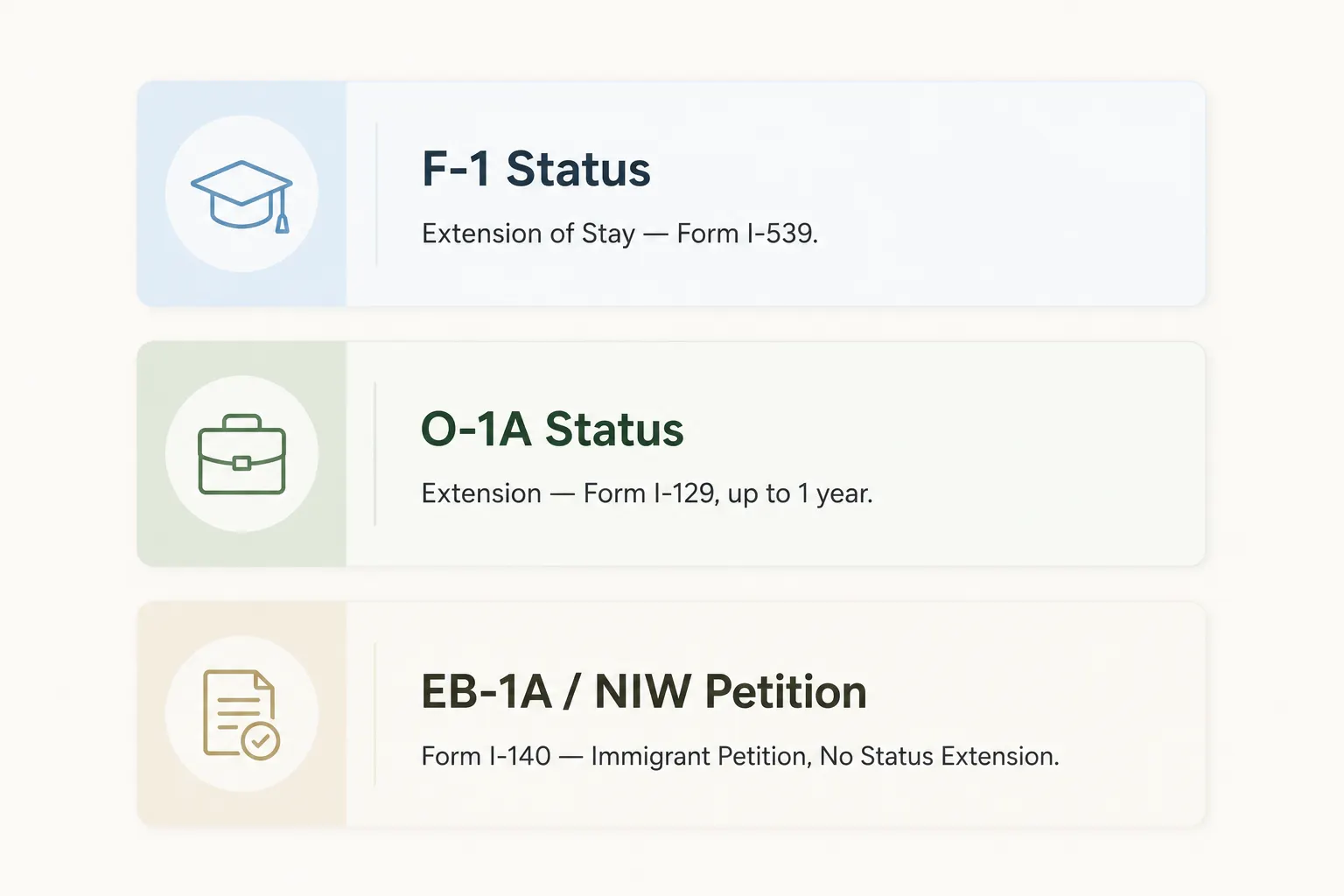
O-1A extensions run through Form I-129, not the new EOS process:
An O-1 or O-2 beneficiary’s extension of stay is authorized in increments of up to one year to continue the same event or activity, filed by the petitioner on Form I-129. Where the extension is based on a new event or activity, USCIS may authorize a period necessary to complete it, up to three years.
There's no statutory cap on how many times O-1A can be extended:
As long as the underlying work and extraordinary-ability basis continue, O-1A extensions can keep being filed in one-year increments with no fixed limit on the total number of extensions.
The transition matters if you're still on F-1 while an O-1A change of status is pending:
If your F-1 fixed admission date could lapse before your O-1A change of status is approved, that gap is governed by the F-1 side of the timeline, not by anything related to O-1A. Filing the O-1A change of status petition with enough buffer before your F-1 admission period ends avoids this becoming an issue.
The new EOS rule is scoped to F, J, and I nonimmigrants:
Under the DHS final rule, F, J, and I nonimmigrants who need to remain beyond their fixed admission period must file an Extension of Stay application with USCIS. O-1A is a distinct nonimmigrant category and isn’t included in this requirement.
Applicants weighing this sequencing can review our F-1 timing breakdown of how the fixed admission period rule affects when to start a change of status.
02-
Does a Pending EB-1A or NIW Petition Change Your Status Obligations?
An EB-1A or EB-2 NIW petition (Form I-140) is an immigrant petition. It establishes eligibility for a green card category. It does not, by itself, grant, extend, or protect any nonimmigrant status, whether that status is F-1, O-1A, or anything else.
Filing Form I-140 doesn't pause your nonimmigrant status clock:
Whether your EB-1A or NIW petition is pending, approved, or denied, your underlying nonimmigrant status still has to be independently maintained and extended on its own schedule, F-1 through EOS if applicable, O-1A through Form I-129.
An approved I-140 doesn't automatically extend nonimmigrant status either:
This differs from certain H-1B-specific provisions that allow status extension beyond the usual limit based on a pending or approved I-140. Those provisions are tied to the H-1B category’s statutory time limits and don’t apply to O-1A, which has no such cap to begin with.
O-1A extensions can continue regardless of where the I-140 stands:
Because O-1A has no maximum duration and no annual cap, it can keep being extended in one-year increments while an EB-1A or NIW petition works its way through USCIS, without needing to reference the I-140 filing at all.
Maintaining status still matters for a future adjustment of status:
If the plan is to eventually file Form I-485 to adjust status inside the US once a priority date is current, staying in valid nonimmigrant status up to that filing (or being in a category that allows a change to adjustment) is what keeps that option open, not the I-140 filing itself.
A recent EB-1A approval shows how an applicant kept O-1A extensions and an EB-1A petition moving on separate, parallel timelines.

FREE EVALUATION
Get a free case evaluation from our team. We’ll map your nonimmigrant status track against your immigrant petition timeline so nothing falls through the gap.
03-
Why Choose Jinee Green Card?
At Jinee Green Card, we’ve helped over 500 professionals secure approvals at a 93 percent rate, across EB-1A, O-1A, and EB-2 NIW. The team includes immigration attorneys and an ex-USCIS officer who has adjudicated extraordinary-ability petitions from inside the agency. Clients often come to us managing an O-1A extension and an EB-1A filing at the same time, and getting the sequencing right on both tracks is part of how we keep a case moving without a status gap.
04-
Frequently Asked Questions
Does an approved O-1A need the new F-1-style Extension of Stay?
No. The new EOS process that takes effect September 15, 2026 applies only to F, J, and I nonimmigrants. O-1A holders extend their stay through a separate, existing process, filed by the petitioner on Form I-129.
How long is a typical O-1A extension?
O-1 and O-2 extensions are typically authorized in increments of up to one year to continue the same event or activity. Where the extension is based on a new event or activity, USCIS may authorize a period necessary to complete it, up to three years.
Is there a limit on how many times O-1A can be extended?
No. There is no statutory cap on the number of O-1A extensions, as long as the beneficiary continues to meet the extraordinary-ability requirements and the underlying work continues.
Does a pending EB-1A or NIW petition extend or protect my nonimmigrant status?
No. Form I-140 is an immigrant petition and does not by itself grant, extend, or protect any nonimmigrant status. Whatever nonimmigrant status you hold, F-1, O-1A, or otherwise, has to be maintained and extended independently.
If I'm still on F-1 with a pending O-1A change of status, do I need to file an F-1 EOS too?
It depends on timing. If your F-1 fixed admission date could lapse before your O-1A change of status is decided, that gap needs to be addressed on the F-1 side. Filing the O-1A change of status with sufficient buffer before your F-1 admission period ends is the way most applicants avoid this.
05-
References

DHS/SEVP — Final Rule: Fixed Time Period of Admission and Extension of Stay (FAQ):
USCIS Policy Manual — Volume 2, Part M, Chapter 9 (O-1 Admission, Extension of Stay, Change of Status):
Disclaimer
This blog is for informational purposes only and does not constitute legal advice. Consult a licensed immigration attorney for guidance specific to your case.
Understand where your profile stands before you file.