
Does the New DHS 4-Year Rule Affect F-1 Students Already on STEM OPT Planning to File EB-1A or O-1A?
No. The rule does not automatically terminate the status of students already maintaining F-1 status when it takes effect. But it does change what happens at the next admission or extension point. These are the exact questions Jinee Green Card has been fielding from STEM OPT students since the rule was announced, so here’s what actually changed, and what it means for O-1A and EB-1A specifically.
Team Jinee
Extraordinary Ability. Precisely Positioned.

September 2026

4 min read
Sept 15, 2026
Rule effective date
Up to 4 years
Maximum single admission period
30 days
Departure period under the new fixed-admission framework
6 months
Window to file OPT/STEM OPT without a separate EOS
On This Page
Does This Change STEM OPT, O-1A, or EB-1A?
Why Choose Jinee Green Card?
FAQs
References
DHS’s fixed-admission rule replaces open-ended duration of status with a specific Admit Until Date, capped at four years per admission period. Students already in the U.S. under D/S are covered by transition provisions tied to their existing program or OPT/STEM OPT authorization, subject to that four-year outer limit, not an automatic switch to a new fixed date on September 15. Certain events, including international travel and re-entry, or an adjudicated Extension of Stay, move a student into the new fixed-admission framework going forward.
The rule changes how a student’s F-1 admission record is set. It does not, on its own, change STEM OPT eligibility, O-1A eligibility, or EB-1A eligibility. What it changes is the calendar a student is working against, and in some cases, when an Extension of Stay filing becomes necessary.
According to Jinee Green Card, “Students read ‘4-year cap’ and assume a countdown started for everyone on September 15. It didn’t. Most students already here are covered by transition provisions tied to their own program or OPT dates. The rule matters most at the next admission point, not as an immediate deadline.”
At Jinee Green Card, our O-1A planning conversations with STEM OPT students now start by mapping their transition-provision timeline against their evidence readiness, since the two calendars don’t always move at the same pace.
01-
What Actually Changed, and What the Transition Rules Really Mean
DHS replaced duration of status with a fixed admission period tied to a student’s I-20 program end date, capped at four years for any single admission period, along with a new 30-day departure period under the fixed-admission framework. Students who need more time generally have to file an Extension of Stay (EOS) with USCIS.
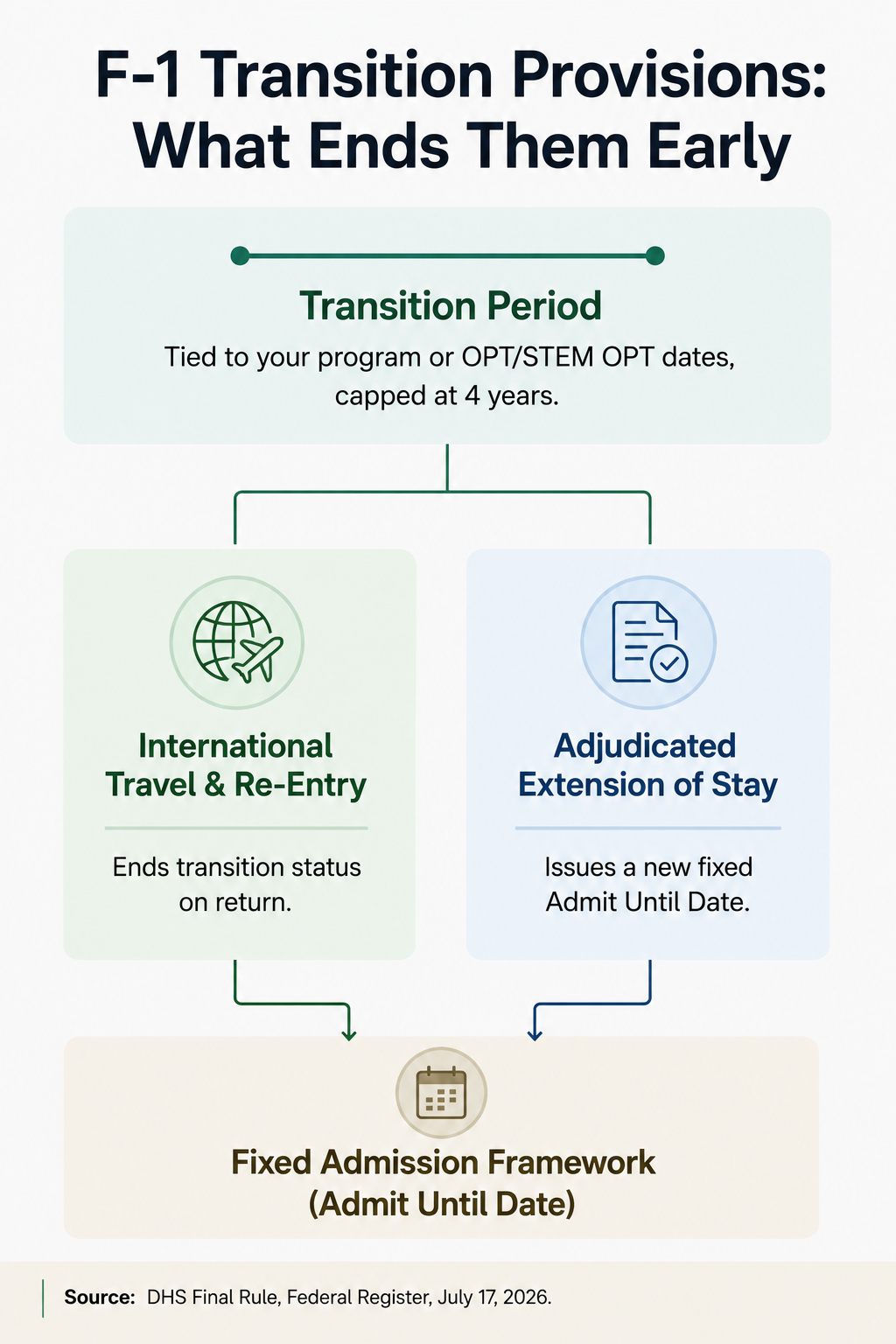
The transition rules matter more than the headline number, and they’re more specific than a single “whichever comes first” cutoff. Students who are already in the United States in valid F-1 status under D/S when the rule takes effect are covered by transition provisions. They generally do not receive a new fixed I-94 automatically on September 15. Their transition period is tied to their existing program or OPT/STEM OPT authorization, subject to the four-year outer limit established by the rule.
Two specific events can still move a student out of transition status early. If a student leaves the U.S. and is readmitted after September 15, 2026, the student will generally enter under the new fixed-admission system and receive an Admit Until Date rather than continuing under the old D/S admission framework. An adjudicated Extension of Stay application has a similar effect, since USCIS issues a fixed Admit Until Date once that filing is decided.
There’s also a carve-out worth knowing. Students with a pending OPT or STEM OPT application when the rule takes effect, or who file one within six months of the effective date (roughly by March 18, 2027), don’t need to file a separate EOS for that specific application.
Travel note: Re-entering the U.S. on F-1 status after September 15, 2026 generally means coming back under the new fixed-admission framework, even for a routine trip. Confirm your status with your DSO before booking anything.
Students still mapping their broader F-1 timeline can review our related guide on the fixed F-1 admission period and when to start an EB-1A or O-1A case.
02-
Does This Change STEM OPT, O-1A, or EB-1A?
STEM OPT: The rule does not eliminate STEM OPT or change its core eligibility requirements. However, it can affect the immigration-status timeline around OPT/STEM OPT, including when an Extension of Stay may be required. Your I-20 program date, your STEM OPT EAD date, and your F-1 admission date are three separate things worth tracking independently.
O-1A: The DHS rule does not change the O-1A eligibility criteria. The significance for STEM OPT students is timing. If your F-1/STEM OPT timeline is approaching an important status or admission deadline and you already have an O-1A-viable profile, O-1A may become an important next-step work-status option.
EB-1A: O-1A and EB-1A answer two different questions. O-1A is a temporary, nonimmigrant work status. EB-1A is an immigrant petition, a step in the green card process, not a work authorization. Neither requires the student to wait for the other. A student can pursue EB-1A without first holding O-1A, and holding O-1A doesn’t obligate anyone to file EB-1A afterward.
This distinction matters in practice: EB-1A is not a replacement for F-1/STEM OPT work authorization while the green card process is pending. Filing an EB-1A petition does not itself give you employment authorization. You still need valid work-authorized status or an applicable employment authorization benefit while the immigrant case is pending. For some students, that looks like a sequence: STEM OPT, then O-1A for continued work status, then EB-1A for permanent residence. That’s one possible path, not a requirement.
For a STEM OPT student thinking long-term:
F-1 → OPT → STEM OPT → O-1A (if eligible) → EB-1A/green-card process
But immediately qualify it:
This is one possible strategy, not a mandatory sequence. “O-1A then EB-1A” should be read as a strategy some students choose, not a rule everyone has to follow.

FREE EVALUATION
Get a free case evaluation from our team. We’ll map your current status against a realistic next step.
03-
Why Choose Jinee Green Card?
At Jinee Green Card, we’ve helped more than 500 professionals get approved, at a 93 percent success rate, across EB-1A, O-1A, and EB-2 NIW. For STEM OPT students navigating this transition, the first step is usually mapping exactly where a student sits under the new rule, before any conversation about O-1A or EB-1A evidence begins. Our immigration attorneys track transition-provision timelines alongside SEVIS status and travel plans, and our ex-USCIS officer has reviewed how officers evaluate both status maintenance and extraordinary-ability evidence from inside the agency.
04-
Frequently Asked Questions
Does the DHS rule immediately end my duration of status?
No. Students properly maintaining F-1 status before September 15, 2026 are covered by transition provisions tied to their existing program or OPT/STEM OPT authorization, subject to the four-year outer limit set by the rule. They generally do not receive a new fixed I-94 automatically on the effective date.
Does filing an EOS keep me under D/S, or end it?
It ends it. Once USCIS adjudicates an EOS, the student is issued a fixed Admit Until Date going forward. The EOS approval itself is what triggers the move into the new system.
Does the four-year cap mean my STEM OPT is being cut short?
No. The four-year figure limits a single F-1 admission period, not STEM OPT itself, which remains governed by its own separate rules.
Do I need a separate EOS to file for OPT or STEM OPT?
Not if you file within six months of the rule’s effective date (roughly by March 18, 2027) or already have an application pending when the rule takes effect. Filing later generally does require a separate EOS.
Does this rule change what evidence I need for O-1A or EB-1A?
No. Both categories are evaluated on the same standards as before. This rule only affects status and timing, not eligibility criteria. It’s also worth noting that filing an EB-1A petition does not itself provide employment authorization. A student still needs valid work-authorized status or an applicable EAD while the immigrant case is pending.
05-
References

DHS Final Rule — Establishing a Fixed Time Period of Admission and an Extension of Stay Procedure (Federal Register)
Study in the States — Final Rule FAQ for F Students
USCIS Policy Manual — Extraordinary Ability (EB-1A)
Disclaimer
This blog is for informational purposes only and does not constitute legal advice. Consult a licensed immigration attorney and your DSO for guidance specific to your situation.
Understand where your profile stands before you file.